Bill-Accurate Kubernetes Cost Allocation, Now Built Into CloudBolt
CloudBolt is introducing granular Kubernetes cost allocation directly within the platform, now available in private preview. This new capability delivers bill-level accuracy down to the container, intelligently allocates shared costs, and integrates natively with enterprise chargeback.
If you’d rather see it than read about it, start with a quick walkthrough of the experience:

Here’s what that looks like inside CloudBolt when you break a single Kubernetes cluster into real, attributable costs.
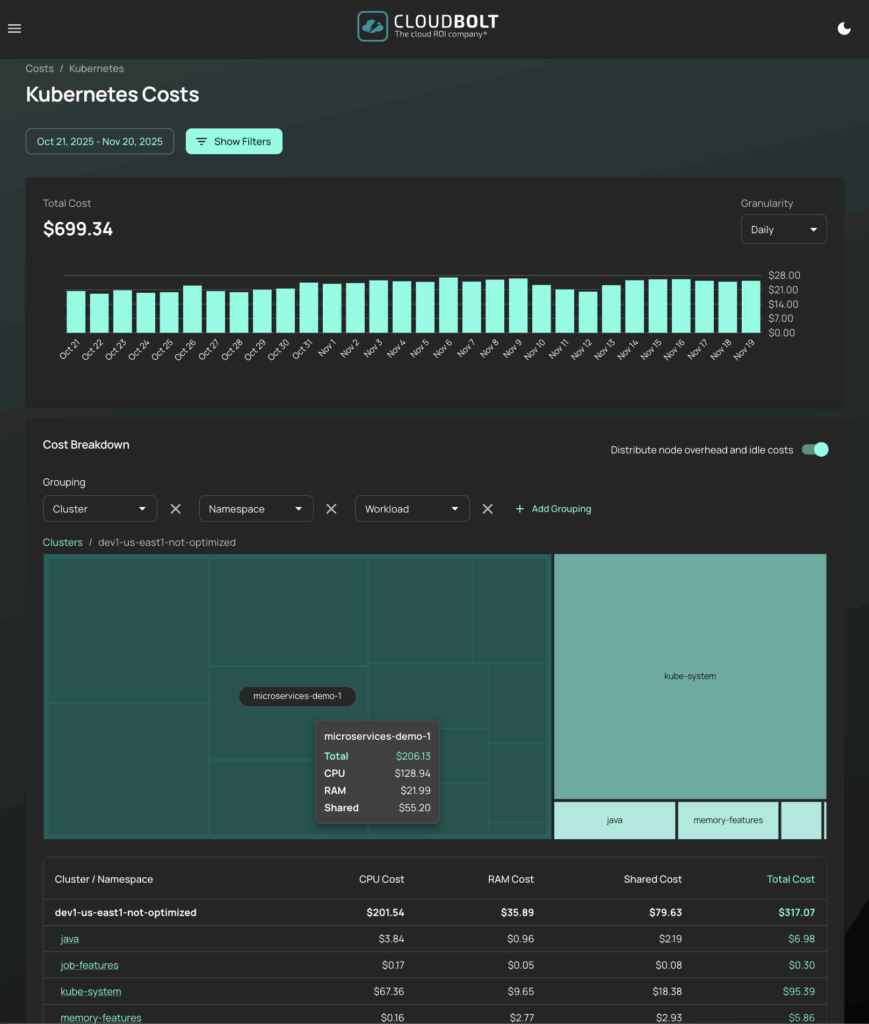
Key capabilities include:
- Container-level cost tracking from real in-cluster metrics—not estimates
- Workload-aware reporting that reflects enterprise discounts, credits, and custom pricing
- Intelligent shared-cost distribution across idle capacity, control plane, and monitoring overhead
- Enterprise-grade chargeback integration that turns technical metrics into business-ready invoices
- Unified cloud-to-container visibility linking tagged cloud resources with labeled Kubernetes workloads
Together, these capabilities close the gap between Kubernetes operations and financial accountability—laying the groundwork for what’s next: connecting cost allocation with CloudBolt’s ML-powered optimization engine to quantify the precise dollar impact of rightsizing recommendations based on your actual enterprise agreements.
This feature is currently in private preview. If you’d like early access and the chance to provide direct feedback to our product team, you can request to join the preview here.
Why It Matters
For years, a hidden tax has been levied on businesses embracing Kubernetes. It’s not a line item on your cloud bill, but every practitioner feels it— the cost of the unknown.
This invisible expense stems from the massive, shared cost of clusters that defy traditional chargeback and accountability. And it’s not just a feeling: 91% of leaders say container complexity now exceeds their finance teams’ ability to manage it.
When you don’t know what your workloads truly cost, you can’t incentivize efficiency. Many organizations fall back on crude workarounds—like running one cluster per app just to simplify billing—an approach that defeats the very purpose of Kubernetes’ shared-resource model.
Kubernetes cost allocation should be as precise as the architectures it powers. Realizing that value means moving beyond approximations to models designed for dynamic, shared infrastructure—ones that deliver financial accuracy teams can trust and act on.
To understand how this gap formed, we have to look at where cloud cost models came from.
How We Got Here
The migration from virtual machines to Kubernetes represents more than just a technological shift—it’s a fundamental change in how infrastructure resources are consumed and allocated. Yet most organizations approach Kubernetes cost management with the same mindset they used for VMs.
In the VM era, cost attribution was straightforward: you provisioned an 8-core, 16-GB instance for a specific application, and that application owned those resources whether it used them or not. Finance could easily allocate that $500/month to the right cost center.
Kubernetes breaks this model entirely. Your cloud provider still bills you for those same underlying VMs, but now you might have 200 different workloads sharing resources across a cluster that costs $200,000 annually. The fundamental question becomes: How do you fairly attribute shared resource costs when utilization is dynamic and workloads span multiple applications, teams, and environments?
The Limits of “Good Enough”
The challenge of Kubernetes cost allocation has not gone unnoticed. Open-source tools have emerged to provide basic visibility, but for any organization where financial accuracy is paramount, “good enough” is a recipe for disputes. Nearly half of organizations—44% to be exact—report they still can’t allocate costs at the workload level, leaving them blind to the true cost of their services.
These tools often have critical limitations:
- They rely on public list prices, failing to account for the enterprise discounts, credits, or savings plans that determine your actual costs
- They’re directionally close but not defensible—because the underlying allocation model is opaque or overly simplistic, finance and engineering teams can’t trust the results or use them for true chargeback
- They lack the chargeback logic required for complex business models, such as fairly distributing the costs of shared or idle resources
Directional accuracy might be fine for a single app owner. But when the model itself can’t be explained or audited, showback becomes disputed and chargeback breaks down.
That’s why CloudBolt took a fundamentally different approach—one built for accuracy and clarity from the start.
How CloudBolt Is Solving It
CloudBolt captures cost data at its source. Instead of operating only at the cluster level, our agent now captures metrics for every individual container on every pod—including usage, requests, and limits. This granular data is then consistently ingested through a modern data pipeline that performs the complex transformations and calculations necessary to attribute costs accurately.
Once those container-level costs are calculated, you can roll them up into reports that finance and leadership actually use.
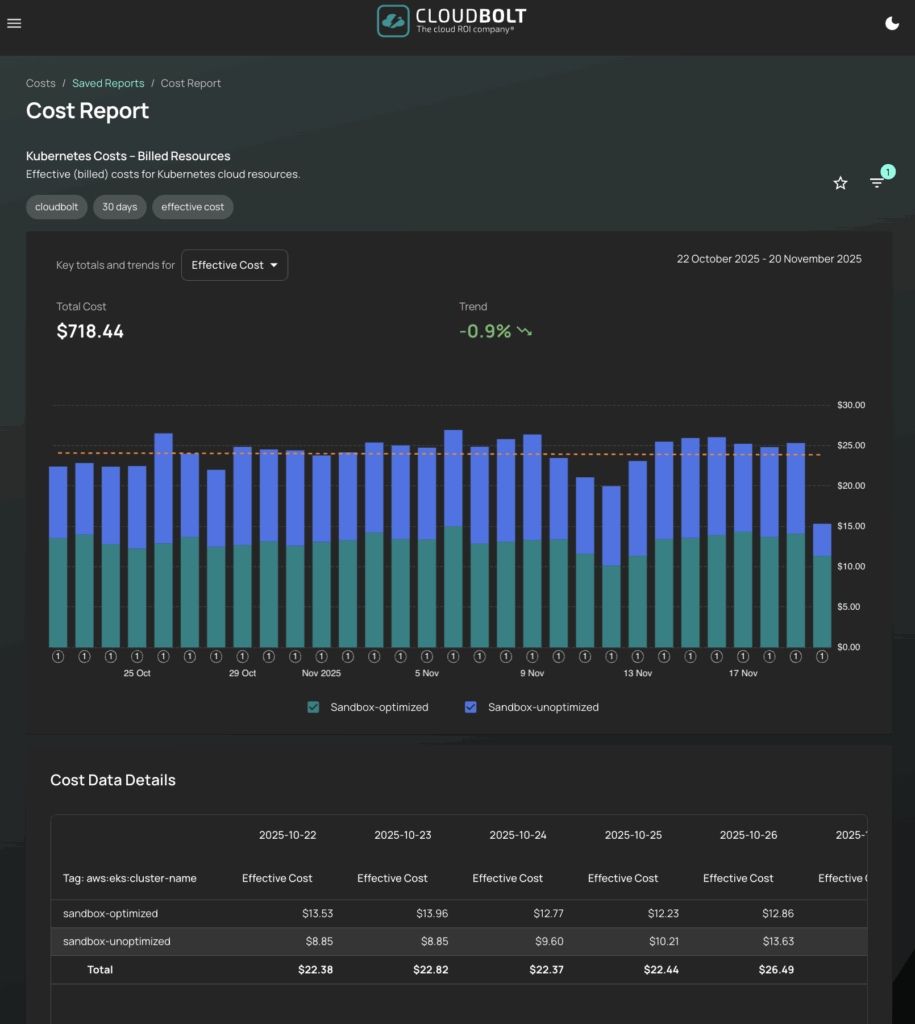
Instead of one undifferentiated “Kubernetes” line item, you get a defensible breakdown of who drove the spend and where optimization will actually matter.
Our architecture ensures the information is not only precise but also available in minutes, not days. It allows us to:
- Connect Cloud and Kubernetes Costs: Associate tagged cloud resources with labeled in-cluster resources to get the full cost of an application
- Distribute Shared and Idle Costs Intelligently: Proportionally allocate costs for control planes, monitoring tools, and idle capacity based on defined business logic
- Integrate with a Best-in-Class Chargeback Engine: Feed Kubernetes data directly into a chargeback system capable of handling multi-tenancy and custom rate cards—turning technical reports into business-ready invoices
Beyond Cost Allocation
Accurate cost allocation is the foundation we are introducing today—and a bridge to a more intelligent optimization experience for Kubernetes.
CloudBolt is uniquely positioned here. We deliver both enterprise-grade chargeback and ML-powered optimization, and this new capability connects the two. Soon, you’ll be able to:
- See a rightsizing recommendation from our ML engine
- Instantly model the exact dollar savings it delivers based on your specific enterprise agreement, not just list price
- Apply optimizations confidently, knowing the financial impact is precise
Cost allocation is no longer just a reporting exercise—it’s the foundation of financial accountability in cloud native operations.
The question isn’t whether your organization will solve Kubernetes cost allocation. The question is whether you’ll solve it with the precision and sophistication that your cloud native architecture deserves.
What’s Next
We’re accepting a limited number of design partners into the private preview. If you’re trying to reconcile Kubernetes spend with your bill—or you’re being asked for customer-, product-, or team-level costs you can’t reliably produce—this program is for you.


Related Blogs

Convergence in 2026: 5 takeaways from Kyle Campos’ Forbes piece (and what to do next)
The last decade of cloud was defined by acceleration. Faster releases, faster scaling, faster everything. But speed also compounded complexity,…