Directionally Close Isn’t Defensible: Reconciling Kubernetes Cost to the Penny
Every Kubernetes chargeback program dies in the same meeting.
The platform team puts together a thoughtful dashboard with costs broken down by namespace, by team, by label. Someone in finance pulls up the actual cloud invoice for the same month, and the two numbers don’t match. They’re not even close; it’s off by thousands of dollars. Things start to get awkward, and people start losing credibility fast…
And then the questions start: Which number is right? Why is there a gap? Whose budget eats the difference?
Nobody has a good answer. So the chargeback initiative quietly gets shelved for another quarter, and everyone goes back to treating Kubernetes as one giant black box on the bill.
This is the reconciliation gap, and it’s the single most underrated reason Kubernetes cost programs stall. The tooling isn’t wrong about where the money is going. It just can’t prove it, which means teams aren’t held accountable, and the energy is spent debating the accuracy of the costs instead of the real problem, getting the costs down.
The number on your dashboard was never the number on your bill
Here’s the uncomfortable mechanics of how most Kubernetes cost tools work.
The cloud provider bills for nodes, but app teams don’t run nodes; they run pods. So to figure out what a pod costs, a cost tool has to take the node price and divide it back down across everything scheduled on that node, which seems simple enough in theory.
One big problem is which node price it uses; most tools reach for the public, on-demand list price, because that’s the number they can look up without seeing your actual bill. They never see the committed-use discounts, the savings plans, the enterprise agreement, the spot pricing, and especially not the credits the procurement team fought so hard for, so they estimate.
And an estimate, by definition, doesn’t reconcile. You can be directionally close, close enough to spot your most expensive namespace, and still be completely indefensible the moment someone wants to bill against the number. As the failure mode gets described over and over by FinOps practitioners: directionally close but not defensible.
The CNCF data backs up how widespread the pain is.
14% of organizations run an active Kubernetes chargeback
~50% saw costs jump after adopting Kubernetes
Source: CNCF FinOps for Kubernetes report
It isn’t that teams don’t want to allocate cost; it’s that they can’t stand behind the allocation, and gaining the trust of the other teams is half the battle.
Why “close enough” is fatal for chargeback specifically
For showback, just showing teams what they spend, directionally close, is demo-ware. People grumble, someone says costs are too high, but no money moves.
Chargeback is different. Chargeback moves real dollars between real budgets. The instant a VP sees their team got handed a $200K shared-cost line they never agreed to, the entire program is on trial, and the first exhibit is the gap between your tool and the invoice. You cannot win that argument with “well, it’s based on list prices, so it’s a little high.”
A number you have to apologize for is a number nobody will pay against.
Defensibility isn’t a nice-to-have feature of cost allocation. For chargeback, it’s the entire feature. If the allocation doesn’t tie to the bill, no argument built on top of it holds.
Think of it like splitting the check
Picture six people splitting a dinner bill.
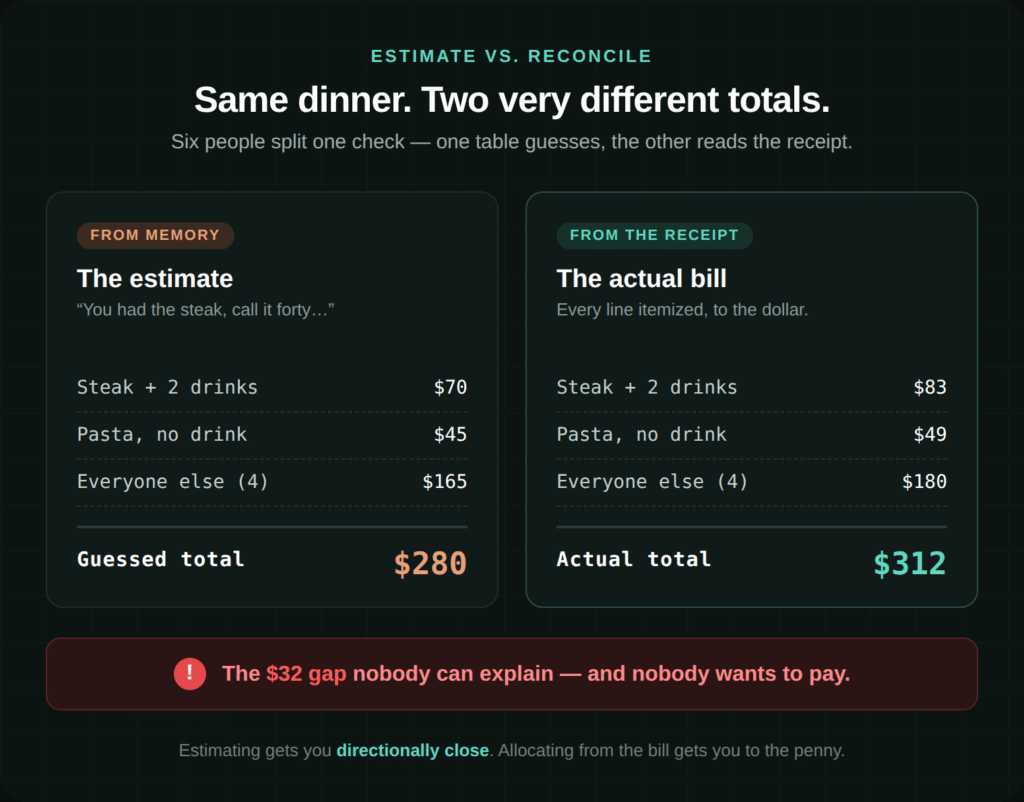
The estimating approach is to go around the table from memory. You had the steak, so call it forty. You had two drinks, maybe thirty? You add it all up, and the total comes to $280. Then the actual receipt lands: $312. Now you’re stuck. Either someone covers the missing $32 out of goodwill, or you do the whole thing again. And every single person at the table has a reason why their estimate was too high.
The defensible approach is to itemize from the actual receipt. Every line on the bill maps to a person. The parts nobody can claim (the shared appetizers, the tip) get split by a rule everyone agreed to up front. When you add it all back up, it equals the receipt. Exactly. There’s no $32 to argue about, because there’s no gap.
That’s the entire difference between estimating Kubernetes costs and allocating them on the bill. One produces a number you defend, the other produces a number you reconcile.
Allocate from the bill, not around it
This is the gap StormForge by CloudBolt was built to close, and the design choice is deliberate: start from the cloud bill itself.
Instead of estimating from list prices, StormForge allocates directly from the Cost and Usage Report: the actual, FOCUS-normalized billing data, with your negotiated rates, committed-use discounts, spot pricing, and credits already baked in. The dollars being divided up are the real dollars your provider charged you, not a public-price stand-in for them.
That single decision is what closes the reconciliation gap. When the dollars come from the CUR, the sum of every allocated slice equals the invoice. Your Kubernetes cost allocation matches your cloud bill to the penny, not directionally or approximately.
To split those real dollars across workloads accurately, StormForge runs an in-cluster agent that captures actual container-level behavior (usage, requests, and limits on every pod) rather than trusting what the control plane thinks is running. The bill supplies the dollars; the agent supplies an honest denominator. You get costs down to the container, pod, namespace, and label, and it still adds back up to the invoice.
Shared and idle capacity (the control plane, monitoring agents, the kube-system overhead nobody owns) gets distributed by allocation rules you define, not a black box:
- Proportional to real consumption, or by whatever business logic the org actually agreed to
- FOCUS-compliant, so the allocation reconciles the same way regardless of the estate
- Consistent across EKS, AKS, GKE, OpenShift, and self-managed clusters—the agent behaves identically no matter how messy the underlying estate is
What changes when your number is tied to the bill
The change isn’t really about precision; it’s about what precision unlocks.
When the allocation reconciles to the invoice, the meeting that used to kill chargeback never happens. Finance pulls the bill, engineering pulls allocation, and they’re the same number. There’s no gap to explain because there’s no gap. The conversation moves on from “is number even real?” to “what are we going to do about the expensive parts?” (Spoiler, that’s when the real fun begins)
That’s the whole point. The waste in Kubernetes is real. Clusters routinely run at single-digit CPU utilization, idle nodes burn money every hour, requests get padded “just in case,” and are never revisited. But you can’t make a team accountable for waste you can’t credibly charge them for. Defensible allocation is the thing that turns a cost dashboard into an actual financial control system, the foundation on which accountability gets built.
Get the number right, and you can finally bill against it. Bill against it, and people start caring what their workloads cost. That’s when the cluster gets cheaper.
Stop reconciling Kubernetes cost by hand. Allocate it from the bill, and let the gap close itself.
See it reconcile to the penny
Watch the demo




Related Blogs

Bill-Accurate Kubernetes Cost Allocation, Now Built Into CloudBolt
CloudBolt now brings granular Kubernetes cost allocation directly into the platform. It delivers bill-level accuracy down to the container, intelligently…