


From request to deployed, governed infrastructure in minutes

Orchestration that thinks like your business
A blueprint is the core building block of CloudBolt CMP. It encodes not just what gets deployed (the cloud target, resource configuration, instance size) but how: the approval chain, cost controls, tagging policy, security requirements, and any post-deployment actions that need to run.
Blueprints are published to a self-service catalog. Any team can browse, request, and deploy approved resources without opening a ticket or waiting on IT. The complexity is abstracted away. The governance is already built in.
See how CloudBolt fits in your environment
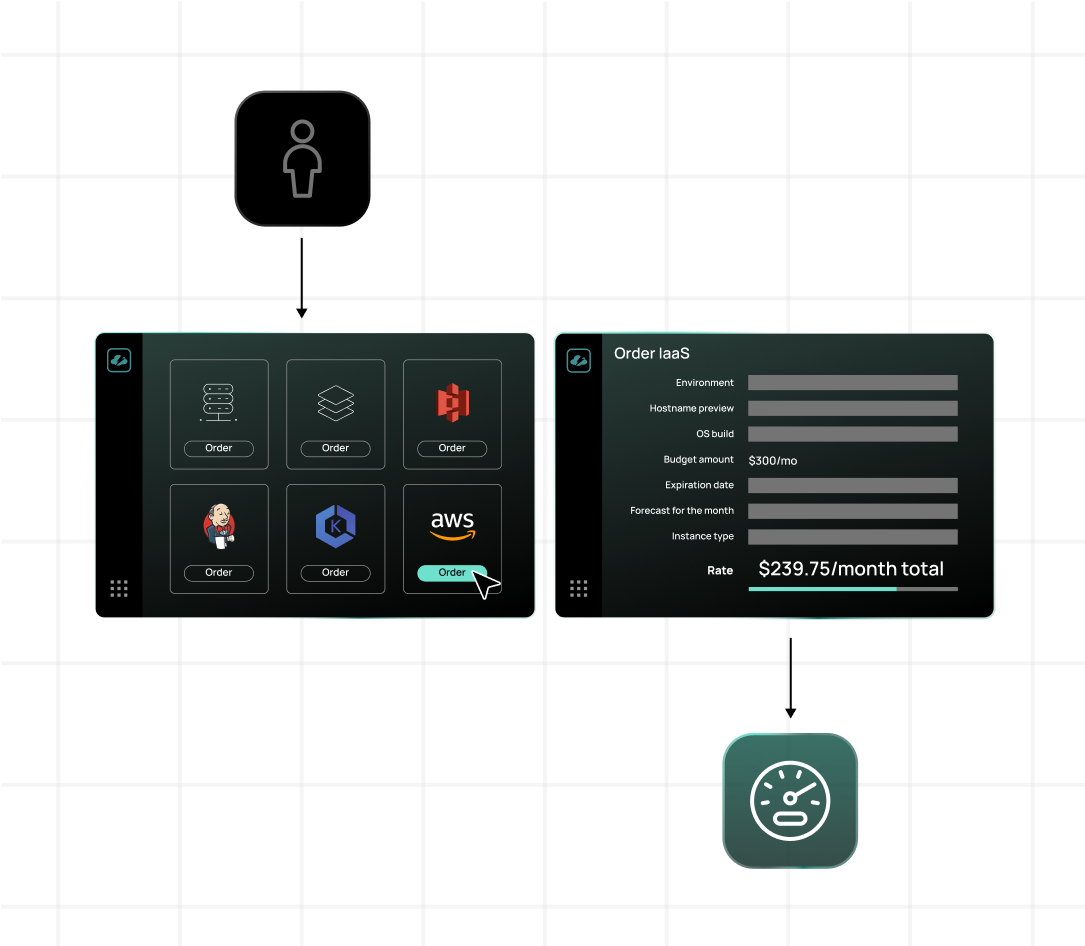
End-to-end workflow orchestration — connect infrastructure, approvals, business logic, and people into automated workflows that run the same way every time
Self-service without chaos — every team gets a catalog to request what they need; governance, cost controls, and approvals are already baked in before anything deploys
Consistent across every environment — the same orchestration logic runs across public clouds, private data centers, Kubernetes, and SaaS from a single control plane
Orchestration as software — manage and version automation workflows in source control, so your orchestration layer is as reliable and auditable as your application code
AI-Ready Operations
Connect AI to your cloud operations —
without losing control
CloudBolt CMP now supports the Model Context Protocol (MCP), making it possible for AI agents and conversational interfaces to interact with your cloud infrastructure through a standardized, governed layer.
MCP Support
AI agents can now interact with CMP through a standardized protocol
Ask questions, initiate workflows, and execute governed cloud actions through natural-language experiences — all through the same control plane your team already trusts.
Governance-First
AI gets access — not a bypass
Every MCP interaction is tied back to the same user permissions, approval workflows, and operational guardrails already established inside CMP. No new governance problem.
A Foundation, Not a Ceiling
Grow into governed AI actions at your own pace
Start by connecting AI-assisted queries and workflow triggers. Expand to full cloud actions as your confidence grows — all within the governance model you already have.
How complex is your cloud, really?
Get a free assessment of your cloud environment to understand what’s driving complexity. Compare your results against industry benchmarks and receive actionable insights to help improve efficiency and governance.
Try the CalculatorAPPROVALS & GOVERNANCE
Governance baked in,
not bolted on
Most teams treat governance as a review layer that sits outside their provisioning workflow — which means it slows things down or gets skipped. CloudBolt embeds governance directly into every blueprint and workflow so it’s automatic and invisible to the end user.

Approval workflows:
- Multi-stage approval chains that route to the right people based on cost threshold, environment type, or resource sensitivity
- Requests above a defined cost escalate automatically; routine requests below threshold auto-approve
- Native integration with ServiceNow, Jira, and other ITSM tools so requests flow through existing processes
- Every approval, rejection, and override logged with timestamp and attribution
Policy enforcement
- Mandatory tagging, ownership, cost center attribution, and security group requirements baked into every blueprint
- Rules engine with if-then-else logic: if production environment, require security review; if cost exceeds budget, block and notify
- Role-based access control (RBAC) with granular permissions across every environment
- Contextual, persona-based access — the right people see only the content relevant to their role, without over-permissioning
- Every resource deployed correctly the first time — not cleaned up retroactively
DAY-2 OPERATIONS
Management doesn’t
stop at deployment
CloudBolt handles the full resource lifecycle — provisioning is just the start. Day-2 covers everything that happens after a resource is live: routine maintenance, configuration changes, scaling, and eventual decommissioning.
Action library: patching, backups, cert rotation, scaling, and software installs on-demand or scheduled
Role-based controls: users only run what their role permits
Automated scheduled tasks: power scheduling, resource cleanup, and recurring maintenance without manual intervention
Reconfiguration workflows: changes to existing resources follow the same approval and governance logic as new deployments
Full audit trail: every action attributed, timestamped, and reportable
Custom day-2 actions: customize how day-2 actions are presented and executed by role, taking self-service to a whole new level

See how Lobster Data cut manual work by 90% with CloudBolt CMP
Watch a short video to see how Lobster Data reduced manual work by 90% and was able to provision workloads 6x faster by enabling safe self-service across departments.
ORCHESTRATION & AUTOMATION
Workflows that connect infrastructure
to your broader operations
Beyond provisioning and lifecycle management, CloudBolt CMP orchestrates complex multi-step workflows across multiple systems, teams, and environments — turning manual processes into automated sequences that run reliably every time.
Conditional logic — workflows branch based on dynamic conditions: environment type, resource state, cost threshold, or output from a previous step
Parallel execution — independent steps run simultaneously, reducing end-to-end workflow time
Event-driven triggers — workflows fire in response to system events: a new deployment, a cost breach, a scheduled time, or an external API call
Actions as code — automation logic lives in source control, versioned and managed like software; review, test, and roll back workflow changes the same way you would application code
Cross-system reach — workflows update a ServiceNow ticket, invoke a Terraform plan, run an Ansible playbook, or send a Slack notification mid-execution
Cost context at the moment it matters
CloudBolt CMP surfaces cost information before a resource is deployed — and keeps that visibility intact throughout the resource lifecycle. Teams make informed decisions; finance teams get the reporting they need.
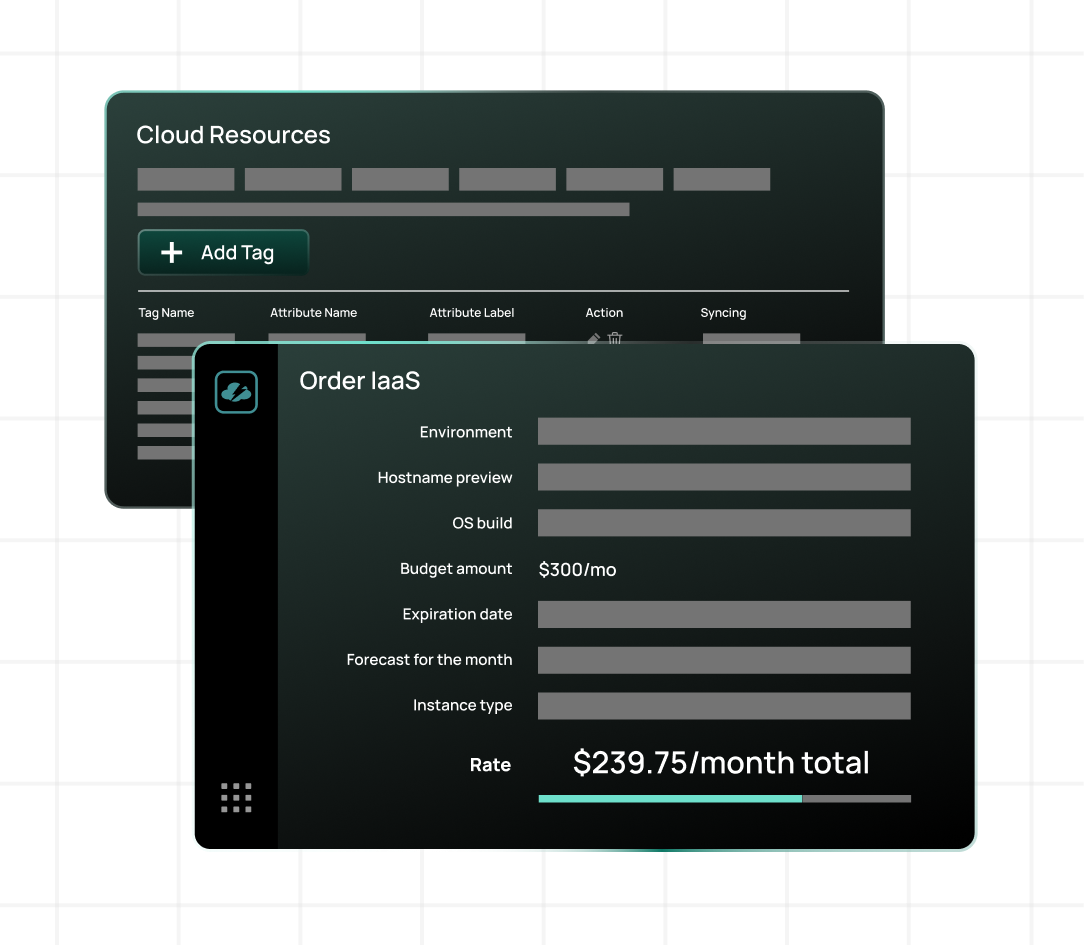
Pre-deployment cost estimates — every blueprint shows projected cost before the request is submitted
Budget enforcement — define budgets at team, project, or environment level; CloudBolt blocks or escalates requests that exceed them
Real cost, not list price — negotiated rates, credits, and committed use discounts applied automatically so projections reflect what you’ll actually spend
Cross-cloud cost visibility — unified reporting across all environments without stitching together separate console reports
EXTENSIBILITY & INTEGRATIONS
No ceiling on what you can build
CloudBolt’s Python-based architecture means there are no fixed boundaries. If it doesn’t support something today, you build it — typically in hours, not months.
Python throughout — all automation logic, integrations, and custom actions written in standard Python; portable, version-controllable, and reusable outside CloudBolt
200+ pre-built integrations — AWS, Azure, GCP, VMware, Nutanix, ServiceNow, Terraform, Ansible, Puppet, Chef, ArgoCD, Flux, Okta, Splunk, Veeam, and more
Any API, any system — if it has an API, CloudBolt can connect to it
GitOps support — manage and version automation workflows in source control for reliable, auditable operations
No lock-in — your code is yours; lift it out and use it elsewhere if you ever need to
Ready to orchestrate beyond the cloud?
Get CloudBolt CMP free

Featured resources
CloudBolt CMP 3-minute demo
Watch this short demo to learn how CloudBolt CMP makes governed self-service provisioning effortless through blueprints, unifies visibility across hybrid cloud environments, and ensures that every deployment follows your standards with built-in role-based access controls. You’ll also see how automated day-2 actions simplify ongoing resource management, and how CloudBolt’s Python-powered extensibility and UI integrations let […]
FAQs
-
What is a CloudBolt blueprint and how is it different from a Terraform module?
A Terraform module handles infrastructure configuration — it defines what gets created. A CloudBolt blueprint wraps that in a complete operational workflow: who can request it, what approvals are required, what cost controls apply, what tags get enforced, and what happens post-deployment. Blueprints typically call Terraform or Ansible under the hood — they’re the governance and workflow layer on top of your existing IaC, not a replacement for it.
-
How does CloudBolt enforce governance without slowing teams down?
By moving governance upstream. Policies are embedded into blueprints before they’re published to the catalog — not reviewed after deployment. A developer requesting infrastructure sees a form, not a governance layer. Tagging, cost controls, security policies, and approval routing all happen automatically. Speed and governance aren’t a tradeoff when both are properties of a well-designed blueprint.
-
What does “actions as code” mean in practice?
Your automation workflows live in source control — Git — the same way application code does. You can review changes before they go live, roll back a workflow if something breaks, run tests against it, and track exactly who changed what and when. It makes orchestration more reliable, more auditable, and easier to hand off between teams.
-
Can CloudBolt replace our existing Terraform and Ansible workflows?
No — and it’s not designed to. CloudBolt orchestrates across your existing IaC tools, wrapping them in approvals, governance, and lifecycle management without rewriting the underlying automation. Your existing investments stay intact; CloudBolt adds the operational layer on top.
-
How does CloudBolt handle environments with multiple clouds and hypervisors?
CloudBolt operates as a single control plane across all of them. Governance policies, approval workflows, and cost controls apply consistently regardless of the underlying infrastructure. This is the core gap native cloud tools don’t fill — they govern well inside their own ecosystem but have no visibility into resources deployed elsewhere.
-
How long does it take to get started?
Most teams are provisioning governed infrastructure within days. CloudBolt connects to your existing tools without rip-and-replace — install, connect your cloud accounts and existing tooling, publish your first blueprints, and you’re live. A sandbox environment is available to explore the platform before touching production.