


Kubernetes automation at the speed of trust
Ready to put Kubernetes rightsizing on autopilot?
Start free trial

What our customers say
Post implementation of [StormForge by CloudBolt], we were able to reduce our cost and the size our infrastructure by over 65% for our web nodes.
What truly sets Stormforge apart is their incredible team—not only is the tool easy to use, but the people behind it are professional, knowledgeable, and genuinely supportive. In a world of over-promising and under-delivering, Stormforge is a company that actually delivers on their promise. It’s a refreshing and valuable partnership.
StormForge has added immediate gains by overall net-capacity savings due to overprovisioned workloads.
Great product – StormForge is great to help to rightsize workloads. Some sizing will save you a ton of money, but I really like that it will also “upsize” a workload as well!
In tackling OOMs, we realized: why treat requests and limits as static when they should adapt to real-time production behavior? Workloads and traffic change, and manual tuning doesn’t scale. With the right tooling and automated recommendations, OOMkills dropped—and cost improvement followed.
Related resources

How Acquia cut web node infrastructure by 65% with continuous Kubernetes rightsizing
Acquia modernized a platform that previously ran on roughly 26,000 EC2 nodes by moving to Kubernetes. The goal wasn’t just containerization—it was elastic scaling for traffic spikes without relying on fixed “small/medium/large” sizing. Results at a glance 65% reduction in web node footprint 99.99% availability delivered consistently 26,000 EC2 nodes as the legacy baseline modernized […]
Kubernetes utilization benchmark calculator
Kubernetes utilization benchmark How does your Kubernetes utilization compare? See how your cluster’s CPU and memory utilization stack up against your industry, and find out where idle spend is hiding. Avg CPU utilization Cluster-wide, last 30 days % Avg memory utilization Cluster-wide, last 30 days % Industry vertical Select an industry…Technology / SaaSFinancial ServicesRetail / […]
The Kubernetes Automation Trust Gap No One Talks About
CloudBolt Research Report — March 2026 The Kubernetes Automation Trust Gap No One Talks About The selective distrust of autonomous Kubernetes rightsizing, and how to overcome it. 321 Respondents| Enterprise Orgs (1,000+)| 100% Kubernetes Practitioners 00Executive summary 01Automation is doctrine 02The moment trust breaks 03High belief, low delegation to automation 04This isn’t irrational 05Scale vs. […]
FAQs
-
Is StormForge delivered as a SaaS solution or available for on-premises deployment?
StormForge uses a hybrid architecture. The StormForge Agent runs entirely within your Kubernetes cluster (on-premises), collecting metrics and applying recommendations locally. The web application and machine learning control plane are SaaS-hosted, accessible at app.stormforge.io. This gives you the security of keeping your workload data within your environment while providing the convenience of a managed service for analysis and recommendations.
-
How is StormForge hosted within Kubernetes environments?
The StormForge Agent is deployed as a Helm chart directly into your Kubernetes cluster in the stormforge-system namespace. It runs alongside your applications, collecting metrics every 15 seconds and applying recommendations locally. The SaaS control plane processes the machine learning analysis and provides the web interface for viewing recommendations and configuring optimization settings. No application data leaves your cluster – only anonymized usage metrics are transmitted.
-
How can recommendations from StormForge be applied?
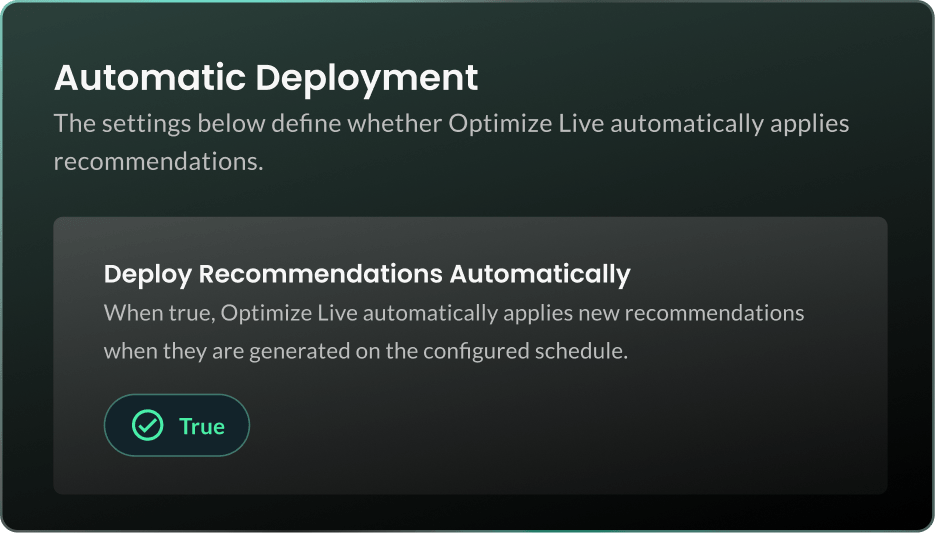
You have complete flexibility in how you apply recommendations. During the initial 7-day learning period, you can only apply recommendations manually for review. After that, you can: 1) Apply recommendations on-demand through the web UI with “Apply Now”, 2) Enable automatic deployment by setting the live.stormforge.io/auto-deploy annotation to “Enabled” for hands-free optimization, or 3) Integrate recommendations into your CI/CD workflow by downloading patches from the UI or using the StormForge CLI. You can also configure deployment thresholds to ensure only impactful changes trigger pod restarts.
-
What is the difference between autoscaling and rightsizing, and how does StormForge support both?
Yes, StormForge provides bi-dimensional autoscaling that combines both approaches. Horizontal autoscaling (like HPA) adds or removes pod replicas in seconds to handle traffic spikes, while vertical rightsizing continuously optimizes the CPU and memory requests and limits for each container over hours, days, and weeks. Unlike basic VPA tools that conflict with HPA, StormForge uses forecast-based machine learning to harmonize both dimensions. We optimize the resource settings of the pods that sit on your nodes (requests/limits), while tools like Karpenter optimize the nodes themselves. This gives you the best of both worlds – rapid scaling for performance and intelligent rightsizing for cost efficiency.
-
How do I know the savings numbers are accurate?
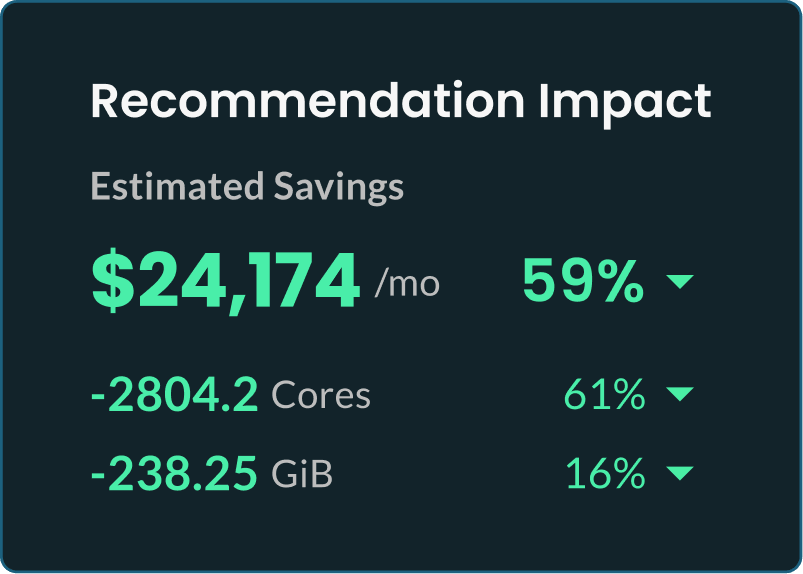
Unlike tools that estimate savings using public list prices, CloudBolt connects your optimization recommendations directly to your actual cloud bills. Savings projections reflect your negotiated rates, committed use discounts, and credits—so the numbers you see are the numbers you’ll actually realize.