

Most tools stop at infrastructure. CloudBolt goes further.
Why CloudBolt?

Bring your own stack
200+ out-of-the-box integrations
Any cloud
AWS, Azure, GCP, VMware, Nutanix, and more

Single-pane of glass
Cross-cloud visibility, cost, and IAM
Orchestration that thinks like your business
End-to-end workflow orchestration
Connect infrastructure, approvals, business logic, and people into automated workflows that run the same way every time.
Self-service without chaos
Every team gets a catalog to request what they need; governance, cost controls, and approvals are already baked in before anything deploys.
Consistent across every environment
The same orchestration logic runs across public clouds, private data centers, Kubernetes, and SaaS from a single control plane.
Orchestration as software
Manage and version automation workflows in source control, so your orchestration layer is as reliable and auditable as your application code.
CMP supported integrations

platform
 Ansible
 Azure DevOps
 CyberArk
 Git
Git
 HashiCorp
 Jenkins
 Progress Chef
 Puppet
 SaltStack
 AppDynamics
 BlueCat
 Citrix
 Cohesity
 Commvault
 Datadog
 Elastic
 F5
HashiCorp Vault
F5
HashiCorp Vault
 Infoblox
 MariaDB
 MongoDB
 MySQL
MySQL
 New Relic
 Okta
Okta
 Oracle
 PostgreSQL
 Prometheus
 Pure Storage
 Rubrik
 SAML
SAML
 ServiceNow
 Slack
Slack
 SolarWinds
 Tintri
 Splunk
 Veeam
Veeam
 VMware
 Alibaba Cloud
 AWS
AWS
 AWS GovCloud
 Azure
Azure Government
Azure
Azure Government
 Google Cloud
 Google Government
 IBM Cloud
 IBM Cloud for Government
OCI
IBM Cloud for Government
OCI
 Canonical
 Cisco
Citrix
Cisco
Citrix
 Dell
Dell
 Docker
 Kubernetes
 MaaS
MaaS
 MetalSoft
 Nutanix
 OpenStack
Oracle
OpenStack
Oracle
 Proxmox
 Red Hat
 SUSE
VMware
SUSE
VMware
The answer to the ecosystem problem
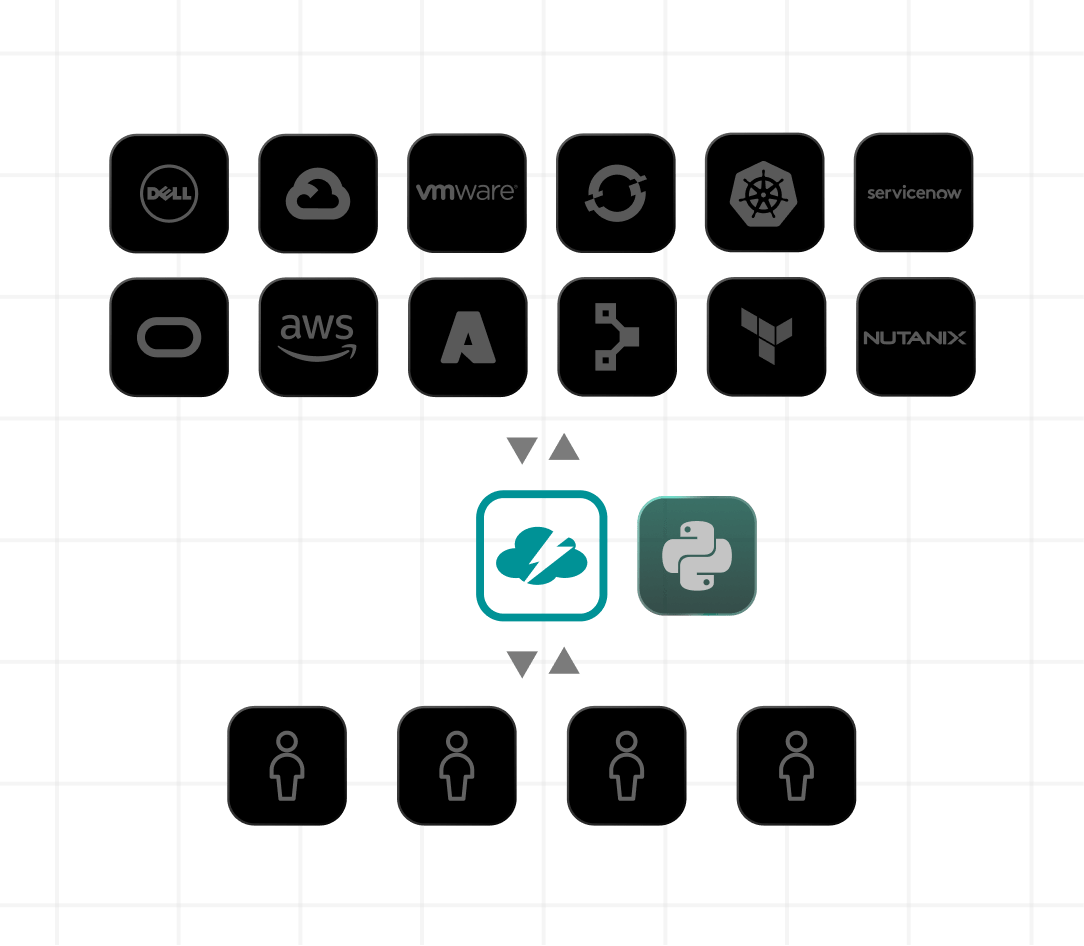
The Broadcom acquisition of VMware was a reminder of what happens when your operations are built inside someone else’s walls. CloudBolt orchestrates across whatever cloud, infrastructure, or tooling you already use — and never holds you hostage to its own.
- No proprietary runtime – everything is Python-based, which means your automation logic is portable; lift it out and use it anywhere.
- Infinitely extensible – when a competitor says “that’s on our roadmap,” CloudBolt customers have already built it; if the platform doesn’t do something today, you write Python and ship it in hours, not months.
- Vendor-agnostic by design – 200+ integrations with major clouds, hypervisors, ITSM tools, IaC frameworks, and GitOps pipelines; no rip-and-replace required.
How complex is your cloud, really?
Get a free assessment of your cloud environment to understand what’s driving complexity. Compare your results against industry benchmarks and receive actionable insights to help improve efficiency and governance.
Start your assessmentDon’t wait till the audit
Native tools govern reasonably well inside one cloud. The problem hits when you’re running two or three clouds with different teams and different toolchains — and no single view of who built what, how, or whether it was done correctly.
- Unified visibility – one view across all resources, environments, and teams; not a collection of console tabs you have to stitch together
- Cross-cloud IAM – know who has the right access across every stack, not just who has access inside a single cloud
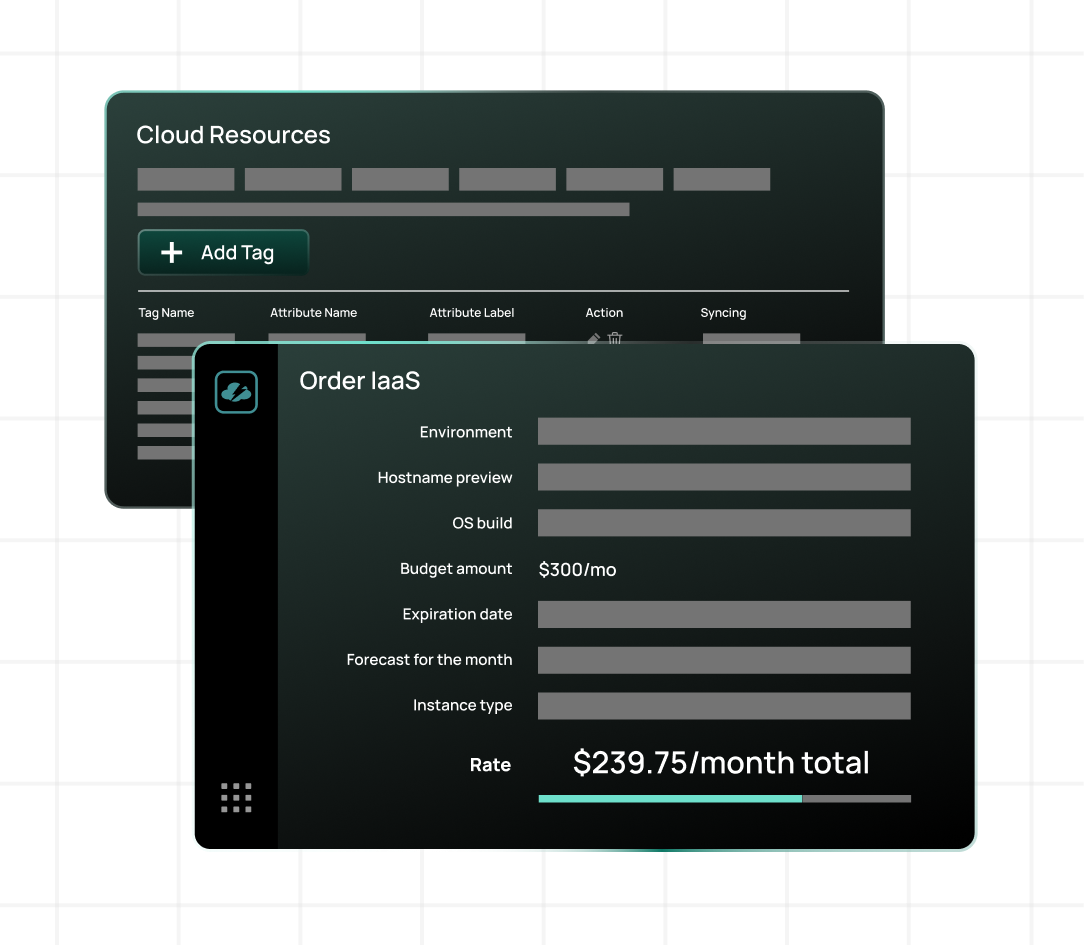
- Governance baked in, not bolted on – tagging, cost controls, security policies, and compliance requirements are built into every provisioning blueprint so nothing slips through
- Consistent, every time – the question isn’t whether you can provision. It’s whether your provisioning is always correct, always governed, done the same way, every time
Ready to orchestrate beyond the cloud?
Get CloudBolt CMP free

Related resources
Broadcom Just Posted Record Earnings. Here’s What They’re Not Telling You.
Broadcom reported earnings this week. Record revenue. $19.3 billion in Q1. VMware bookings exceeding $9.2 billion in total contract value. VMware ARR growing 19% year-on-year. On paper, this looks like a company executing flawlessly on one of the most aggressive acquisitions in tech history. But I’ve spent the last several months in rooms with Fortune […]
How Lobster Cut Manual Work by 90% and Scaled 5x with CloudBolt
Lobster, Germany’s pioneering data integration software company, is known for its motto “connecting people and data for a better future.” Its data platform connects systems without coding, automates workflows, and harnesses insights to simplify its 2,000+ global customers’ data journey. Results at a glance 90% less manual work 6x faster provisioning 30K jobs/month @ 90% success Scaled operations 5x with +2 engineers Company-wide adoption across […]
FAQs
-
What is cloud orchestration and how is it different from provisioning?
Provisioning creates a resource. Orchestration coordinates everything that happens before, during, and after — approvals, governance, integrations, notifications, cost controls, and handoffs between teams. Most organizations already have provisioning covered with Terraform or native cloud tools. What they lack is a way to guarantee that provisioning is consistent, governed, and repeatable across every cloud, every team, every time. That’s what cloud orchestration solves.
-
How is CloudBolt different from using native cloud tools like AWS CloudFormation or Azure Blueprints?
Native tools work well inside their own ecosystem — but they don’t talk to each other. When you’re running workloads across AWS, Azure, and VMware, you end up context-switching between consoles, enforcing policies inconsistently, and stitching together separate cost reports. CloudBolt provides a single orchestration layer across all of them, with consistent governance, unified visibility, and one set of workflows regardless of what’s underneath.
-
What does “no lock-in” mean in practice?
CloudBolt’s automation logic is Python-based, which means it’s portable — you can lift your workflows and use them elsewhere. You’re not building inside a proprietary runtime that only works within CloudBolt’s ecosystem. If you change cloud providers, add a new hypervisor, or swap out a tool, your orchestration layer adapts. The Broadcom acquisition of VMware illustrated what happens when you’re built inside someone else’s walls — CloudBolt is designed to be the alternative to that situation.
-
How extensible is CloudBolt really?
There’s no ceiling. If CloudBolt doesn’t support something out of the box, you write Python and it’s in your stack — typically in hours, not the 18-month roadmap cycle you’d face with most vendors. This is one of the top reasons CloudBolt wins competitive deals, and it’s often something prospects only discover during the sales process. Any system with an API can be integrated; any workflow logic can be built.
-
When do organizations typically realize they need CloudBolt?
Usually after the fact — after a security audit reveals inconsistent provisioning, after sprawl has accumulated across multiple cloud accounts, or after an incident exposes gaps in governance. As Shawn Petty at CloudBolt puts it: “People typically realize they need our tool after they need our tool.” The goal of this page is to help teams recognize the signs earlier: multiple clouds, different teams, no single view, inconsistent standards.
-
Does CloudBolt replace Terraform, Ansible, or other IaC tools?
No. CloudBolt connects to and orchestrates across your existing IaC tools — it doesn’t replace them. Terraform, Ansible, Puppet, Chef, and similar tools handle configuration and provisioning; CloudBolt wraps them in governance, approvals, lifecycle management, self-service, and cross-cloud workflow logic. Your existing investments stay intact; CloudBolt adds the orchestration layer on top, making things that they don’t do possible.