Cast AI Alternative: ML Pod Rightsizing Without Replacing Karpenter
Cast AI has earned its place on Kubernetes cost optimization shortlists. Its node engine autonomously selects instance types, orchestrates Spot capacity with a 30-minute interruption prediction window, and reduces node spend by 50-75% at scale. Those results are real, and for teams whose primary pain is node cost, Cast AI is a viable choice.
However, its adoption has an operational downside: Cast AI’s full node autoscaler still replaces Cluster Autoscaler. It also replaces Karpenter, the open source node provisioner, unless you take Karpenter Enterprise, which extends Karpenter instead of swapping it. Committing to the full Cast AI node engine means migrating node tooling you already trust. The Enterprise path does not.
There is also another question worth considering: Does the larger savings opportunity lie at the node layer or within the workloads themselves, where overprovisioned CPU and memory requests inflate every scaling decision a node autoscaler makes?
As a Cast AI alternative, StormForge by CloudBolt approaches the problem from the workload layer. It uses machine learning to continuously rightsize pod CPU and memory requests, and it runs within the node autoscaling stack you already operate. In this comparison, we explain the differences and trade-offs between the two and show how they affect cluster administration.
Summary of StormForge vs. Cast AI capabilities
| Capability | StormForge by CloudBolt | Cast AI |
| ML-powered pod rightsizing | Individual machine learning models for each workload; changes applied automatically with approval workflows and rollback | Percentile-based targets from a configurable look-back window; no workload-type classification |
| Trust in automation and deployment controls | Auto-deploy off by default; continuous learning; change thresholds; incremental rollout; in-place pod resizing on Kubernetes 1.33+ | Applies recommendations once a confidence threshold based on metric coverage is met |
| Coexistence with existing node autoscaling | Runs alongside Karpenter, Cluster Autoscaler, and native HPA; adjusts HPA target utilization to preserve scaling behavior | Full node engine replaces Cluster Autoscaler or Karpenter; Karpenter Enterprise runs alongside open source Karpenter. Manages native HPA objects |
| Automated node-layer management | No node-layer automation; pod-level rightsizing only | Autonomous instance selection, Spot management with 30-minute interruption prediction, GPU sharing via time-slicing, and MIG |
| Kubernetes cost visibility | Projected cost impact and realized savings by workload, namespace, and cluster; container-level cost allocation reconciled against FOCUS billing data, with shared and idle cost distribution for showback and chargeback | Cost monitoring with a free tier; organizational cost report across clusters, regions, and providers |
| Pricing and total cost of ownership | $3/vCPU/month with no base fee or minimum commitment; volume discounts at larger footprints; 30-day free trial; up to 80% savings guarantee in 30 days | Tiered plans from $1,000/month plus a metered charge of about $5 per managed CPU per month |
How to evaluate a Cast AI alternative
If you are weighing a Cast AI alternative, the six criteria below are where the differences show: ML-powered pod rightsizing, automation, trust, and deployment controls; coexistence with existing node autoscaling; automated node-layer management; Kubernetes cost visibility; and pricing and total cost of ownership. Comparing StormForge by CloudBolt to Cast AI reveals a clear split. StormForge is the better fit for workload-layer depth and deployment control, while Cast AI is better for node-layer breadth and cost monitoring. The sections that follow work through each criterion in order, starting with pod rightsizing.
ML-powered pod rightsizing
Cast AI’s workload autoscaler
Cast AI includes pod rightsizing as part of its automation suite. The workload autoscaler builds recommendations from historical usage collected over a configurable look-back period and applies them once a confidence threshold based on metric coverage is met. It is a working implementation of usage-percentile rightsizing: Derive resource targets from the usage distribution across the look-back window, then apply them.
StormForge’s workload-type models
StormForge models workloads individually before setting resource targets. Every workload receives distinct resource recommendations based on historical CPU and memory usage patterns rather than a static snapshot of current utilization.
The distinction shows up in workloads with predictable cycles. Consider a batch job that peaks nightly at 2 AM. Cast AI, the percentile-based model, sizes the job based on the usage distribution across the whole look-back window, so hours of near-idle usage dilute the nightly peak, and the target can undershoot it. StormForge considers hourly, daily, and weekly seasonal trends in historical data and provisions for known peaks and steady-state usage. It then applies recommendations automatically on a schedule so that workloads have the resources they need when they need them while relinquishing an appropriate amount to reduce waste during steady-state usage.
StormForge also extends recommendations beyond requests. It rightsizes limits, recommends Java heap sizes for JVM workloads, and generates pod scheduling recommendations. Changes are applied automatically on a configurable schedule, so no engineering action is required after each optimization cycle. In organizations where the capacity to review manual recommendations is limited, the gap between “recommendation visible on a dashboard” and “change applied to a running workload” is where the potential for savings typically goes unrealized.
Key insight: If your clusters carry workloads with predictable cycles, workload-type classification provisions can be based on the known demand from the first cycle. If your environment is dominated by high-churn stateless services with genuinely irregular traffic, Cast AI’s percentile model adapts quickly, and the classification advantage narrows.
Trust in automation and deployment controls
Why the trust model affects adoption
Rightsizing automation fails in practice when teams cannot control the blast radius of a bad change. Most teams that abandon automated rightsizing do so after a single incident in which the tool resized a production workload at the wrong time. The evaluation question is not whether a platform can apply changes automatically but how gradually it lets you hand over that control.
StormForge’s graduated controls
StormForge ships with auto-deploy disabled by default. Every new workload goes through a learning period—seven days by default, but configurable to address shorter lived workloads—during which the platform generates preliminary recommendations that can be reviewed and applied on demand but are never deployed automatically. Turning automation on is an explicit, per-scope decision: Configuration applies at the cluster, namespace, or individual workload level, so a team can automate development namespaces while production stays recommendation-only.
Beyond the on/off switch, three controls shape how changes land. Auto-deploy thresholds skip low-impact recommendations unless the change exceeds a defined percentage or unit amount. Incremental rollout caps how much any single change can move a request value, converging on the target across several cycles rather than in a single jump. And on Kubernetes 1.33 and later, webhook-based apply methods resize pods in place without a restart, removing the disruption cost of applying a recommendation.
The three controls can be configured together at the namespace level via annotations (or via CRD based configuration) that enable auto-deploy, set the learning period, define CPU and memory change thresholds, and cap the maximum decrease per apply. An example is presented in the next snippet:
apiVersion: v1
kind: Namespace
metadata:
  name: payments
  annotations:
    live.stormforge.io/auto-deploy: "Enabled"
    live.stormforge.io/learning-period: "P7D"
    live.stormforge.io/auto-deploy.thresholds.cpu.percent: "10"
    live.stormforge.io/auto-deploy.thresholds.memory.percent: "10"
    live.stormforge.io/apply.max-percent-decrease: "20"
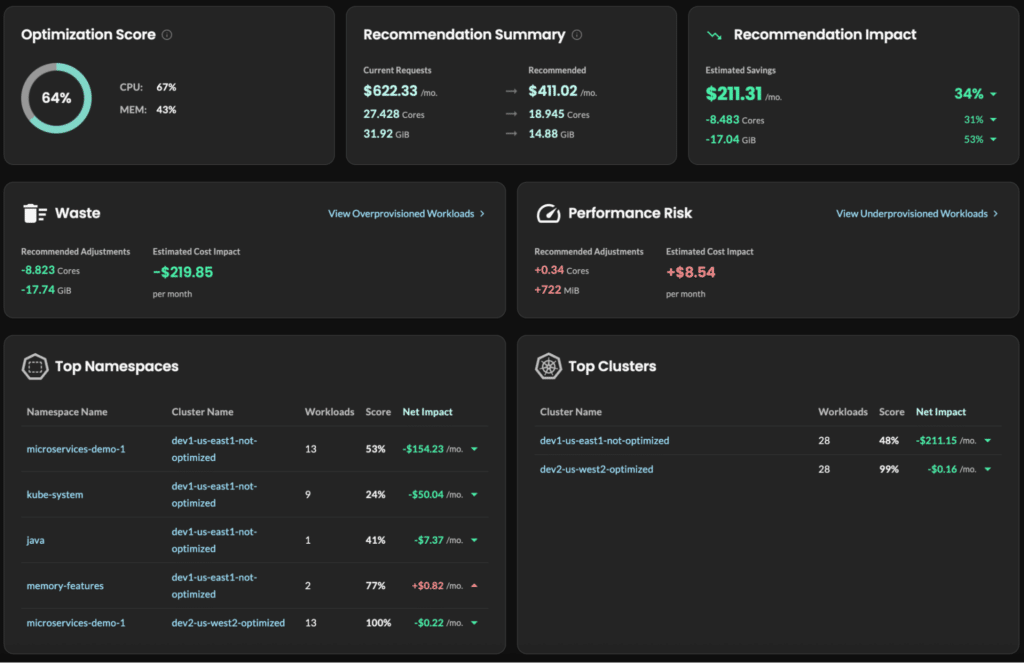
With this manifest applied, StormForge treats the payments namespace as opt-in. It runs the seven-day learning period, holds every recommendation for review, applies only changes that clear the 10% CPU and memory thresholds, and caps any single decrease at 20%. During that learning window, each workload shows its preliminary recommendation and projected cost impact before it deploys.
Cast AI’s confidence threshold
Cast AI’s workload autoscaler applies recommendations once its confidence threshold, based on metric coverage, is met. Scaling policies group workloads and control application behavior. The model is built for teams that want automation to be quick rather than staged over weeks, which matches Cast AI’s overall positioning. The platform’s value is autonomy, and its controls tune that autonomy rather than gate it.
Key insight: If your organization has been burned by autoscaling tooling before, StormForge’s default-off automation, learning period, and incremental rollout let you separate observation from action until trust is earned. If your team already runs full automation elsewhere and wants speed, Cast AI’s confidence-threshold model gets there faster.
Coexistence with existing node autoscaling
Cast AI’s integrated engine
Cast AI’s node automation is a replacement for Cluster Autoscaler. The full node engine also replaces Karpenter, so adopting that path means migrating configuration you already run. Karpenter Enterprise is the other path: It runs alongside open source Karpenter and adds scheduled and continuous rebalancing on top of it. At the workload layer, Cast AI manages native HPA objects through its own scaling logic rather than replacing them. For teams early in their Kubernetes journey with little node tooling to replace, this integrated approach is a feature, since one platform owns the whole scaling stack.
StormForge alongside Karpenter and HPA
StormForge operates only on workload resource settings, so it slots into an existing stack without displacing anything, allowing teams to continue to leverage tenured tools in the Kubernetes ecosystem. Karpenter or Cluster Autoscaler keeps managing nodes, while native HPA keeps managing replicas. StormForge adjusts the CPU and memory requests those systems act on, and because HPA scaling is calculated as a percentage of requests, it adjusts HPA target utilization in step so the workload keeps scaling at the same load level it did before.
The two layers operate synergistically. Node autoscalers bin-pack pods based on their requests; when requests are inflated, every node-level decision inherits the waste. Rightsized requests mean Karpenter provisions fewer, better-fitted nodes with no change to its configuration. GitOps teams are covered too, with documented integration paths for Argo CD and Flux.
Key insight: If you have invested in Karpenter, StormForge adds workload-layer savings without touching that investment. If you are starting from scratch, Cast AI’s single integrated engine may be simpler than assembling a stack.
Automated node-layer management
This is Cast AI’s core capability and the criterion where it clearly leads. The node engine autonomously selects instance types across Spot and on-demand pools, manages Spot inventory, and rebalances workloads without manual configuration. The interruption prediction model flags at-risk Spot nodes up to 30 minutes ahead, giving workloads time to migrate before users notice. GPU sharing via time-slicing and Multi-Instance GPU (MIG) provides a production-ready story for AI and ML inference, enabling multiple tenants to share GPU nodes. Cast AI extended coverage in February 2025 with on-premises support for OpenShift, Rancher, Oracle Cloud, IBM Cloud, and Linode.
StormForge does not operate at this layer. Node selection, Spot management, and instance purchasing decisions are outside its scope by design. Teams that want node-layer automation alongside StormForge get it from Karpenter, which handles instance selection and consolidation as an open-source component, or from cloud-native options like EKS managed node groups with Spot. What that stack does not include is Cast AI’s Spot interruption prediction or its GPU sharing layer.
Key insight: If node-layer automation is the primary objective and replacing Karpenter, or moving to Karpenter Enterprise, is acceptable, Cast AI is the stronger product at that layer. If node automation is already solved in your stack, its advantage here may not justify the migration.
Kubernetes cost visibility
Cast AI’s cost monitoring
Cast AI offers cost monitoring with a free tier, lowering the cost of starting an evaluation. Paid plans report resource utilization by workload, namespace, and team label, along with savings reports quantifying the reduction in node costs. An organizational report aggregates spend across clusters, regions, and cloud providers.
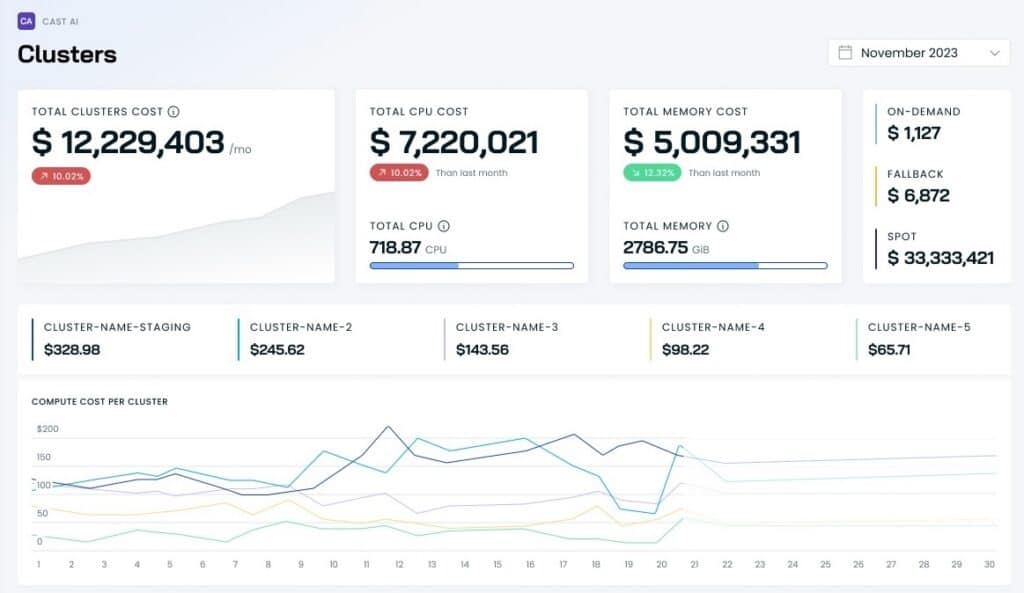
The documented cost model uses instance pricing rather than cloud billing exports, splitting compute costs between CPU and memory at a fixed ratio extrapolated from GCP list pricing. For engineering awareness, that is usually sufficient. The Harness comparison guide notes the boundary clearly: Cast AI lacks support for key governance tools, such as budgets, multi-cloud chargebacks, and detailed reporting for non-Kubernetes environments.
StormForge’s cost reporting and allocation
StormForge started as an optimization tool, and optimization reporting is still the center of it. Each recommendation carries a projected cost impact, and the platform tracks realized savings as changes are applied. Kubernetes cost allocation now sits in the same product. The allocation layer maps container-level telemetry, collected every 15 seconds, against billing data that follows FOCUS, the FinOps Open Cost and Usage Specification, including negotiated rates, committed-use discounts, and credits.
Shared and idle capacity is distributed by proportional or custom rules, so spend lands on a team, application, or business unit instead of an unallocated bucket. The capability is in private preview as of August 2026. OpenCost, the CNCF allocation specification, and Kubecost, which builds on it, remain the Kubernetes-native options for teams that already run them. CloudZero covers cloud-wide reporting when Kubernetes is one line in a larger estate. Recommendation data also exports to APM tools for teams that centralize reporting there.
Key insight: Both platforms now monitor and allocate, so the split is the rate source: Cast AI estimates from instance list prices, while StormForge reconciles against the cloud bill. If cost visibility is already handled by Kubecost, OpenCost, or a cloud cost platform, StormForge adds the optimization layer without duplicating what you have.
Pricing and total cost of ownership
Cast AI’s pricing model
Cast AI’s Growth plan is available on AWS Marketplace for $1,000 per month, including up to 4 managed clusters and up to 500 CPUs charged based on usage. GrowthPro lists at the same $1,000 monthly base, with unlimited clusters and up to 2,000 CPUs, while the Enterprise tier lists at $5,000 per month with unlimited CPUs. In addition to the base fee for each tier, the Marketplace contract adds a metered charge of $0.00694 per managed CPU per hour (about $5 per CPU per month). List prices exclude discount negotiation, so the practical TCO question is how metered charges accumulate as clusters grow. G2 reviewers with large production environments flag pricing complexity at scale as a recurring concern.
The relevant calculation is not whether Cast AI reduces node spend but what fraction of those savings the platform fees consume as the cluster grows. At a few hundred CPUs, the math is favorable, but at several thousand CPUs, the metered charges become a material line item.
StormForge by CloudBolt pricing
StormForge prices at $3 per vCPU per month (or $0.0041 per CPU per hour) on AWS Marketplace, with no base fee. Spend tracks usage directly, so the list rate at 200 vCPUs is the list rate at 5,000. At larger footprints, volume discounts are negotiated through an annual commitment or an AWS Marketplace private offer. The direction is what separates the two models. Cast AI’s tiers step the bill up at a boundary. StormForge’s discounts step the rate down as the footprint grows. A 30-day free trial covering a full cluster is available for self-serve. CloudBolt backs the results with a specific guarantee: up to 80% savings and increased reliability within 30 days, with cancellation at no cost for any reason inside that window. It is the only commitment of its kind in the Kubernetes rightsizing market today.
Key insight: If your cluster count and CPU footprint are growing, compare the two models at your projected scale, not your current one. A flat per-vCPU rate and a base-plus-metered contract diverge fast past a few thousand CPUs.
Which platform fits your environment?
Neither platform is the right choice for every environment.
Choose StormForge by CloudBolt if your savings opportunity sits in overprovisioned workloads and you want ML-driven rightsizing that provisions for known demand shapes rather than percentile snapshots. StormForge is also the right fit if your organization needs graduated automation controls, with a learning period, thresholds, and incremental rollout that let production teams adopt automation at their own pace. And if you have invested in Karpenter, Cluster Autoscaler, or HPA configurations, StormForge adds workload-layer optimization without requiring you to replace any of it.
Choose Cast AI if your primary objective is node-layer automation: autonomous instance selection, Spot orchestration with interruption prediction, and rebalancing across pools. Cast AI can also help with AI and ML platforms, where GPU sharing across tenants via time-slicing and MIG reduces idle GPU spend.
The two products optimize different layers, and some teams ultimately run rightsized workloads on autonomously managed nodes. The practical way to settle the evaluation is to test where your waste actually lives: Run StormForge’s 30-day trial on one production cluster, compare the projected workload savings against a Cast AI node-layer assessment of the same cluster, and let the numbers pick the platform.


Related Blogs
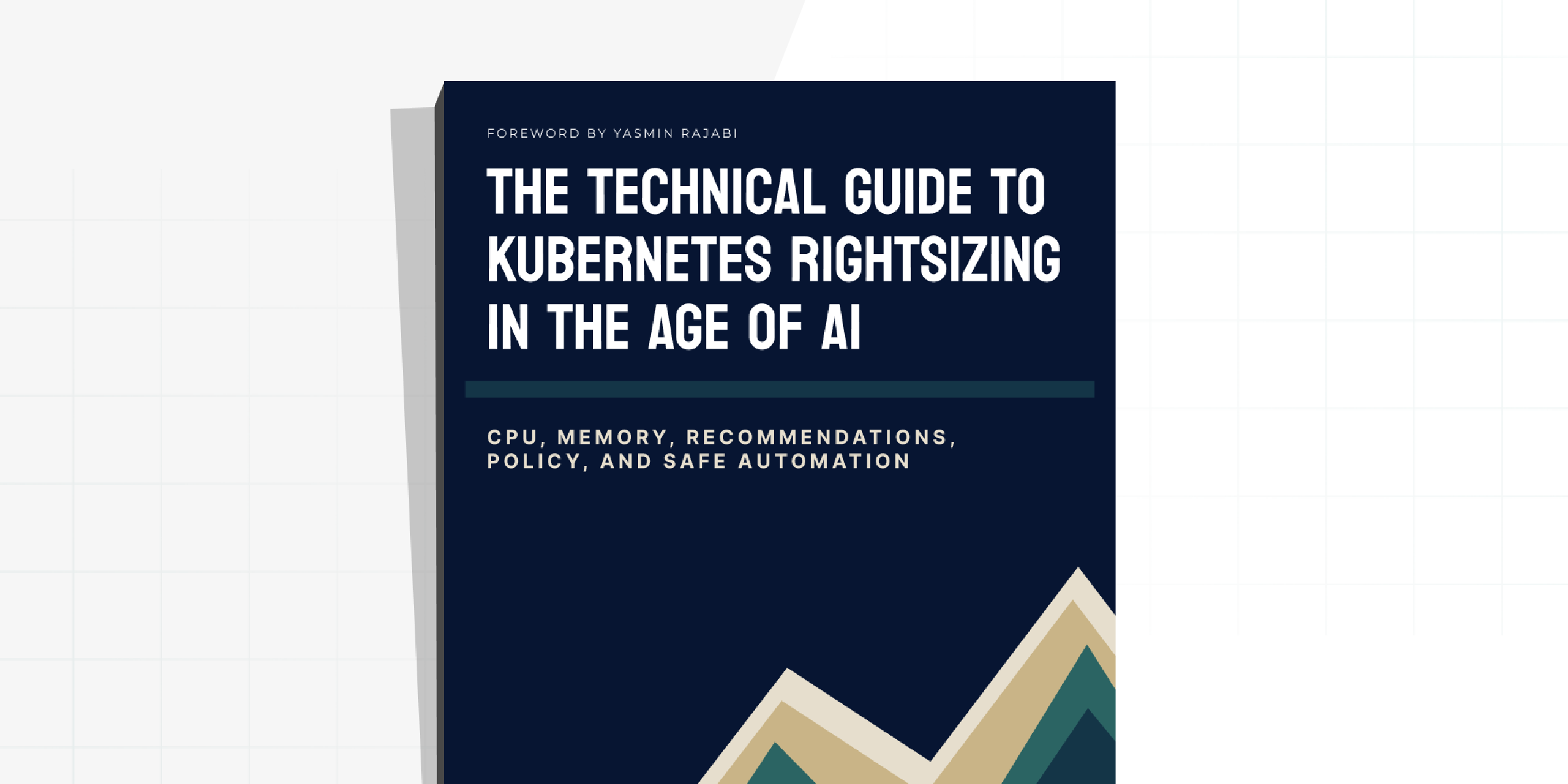
The Technical Guide to Kubernetes Rightsizing from LearnKube
The Technical Guide to Kubernetes Rightsizing from LearnKube is a comprehensive, hands-on guide to safely optimizing CPU and memory across…