The VMware Decision Window: Waiting Is Getting More Expensive
Most enterprises did not respond to the Broadcom acquisition with a clean exit. In fact, they’re still working through their response, most often through phased risk reduction: selective migrations, contract extensions to buy time, and incremental efforts to reduce VMware dependence.
As a CTO put it to us earlier this year, “I’m running a multi-billion-dollar business on an engine I can’t swap mid-flight. Honestly? If I could go back, I wouldn’t have fought the price—I would have negotiated for five years just to buy the time I need to find the exit.”
This is the VMware decision window.
It is not a date. It is the period when organizations can still reduce dependence deliberately, before renewal timing and operational constraints force a less favorable sequence of decisions.
The core issue is not whether an organization can fully leave VMware. Many cannot, at least not quickly (and some may never at all).
But for those that can, it’s about whether VMware pricing and packaging changes will continue to dictate infrastructure strategy. When that happens, the organization has exposure, not optionality.
What the data says, in practical terms
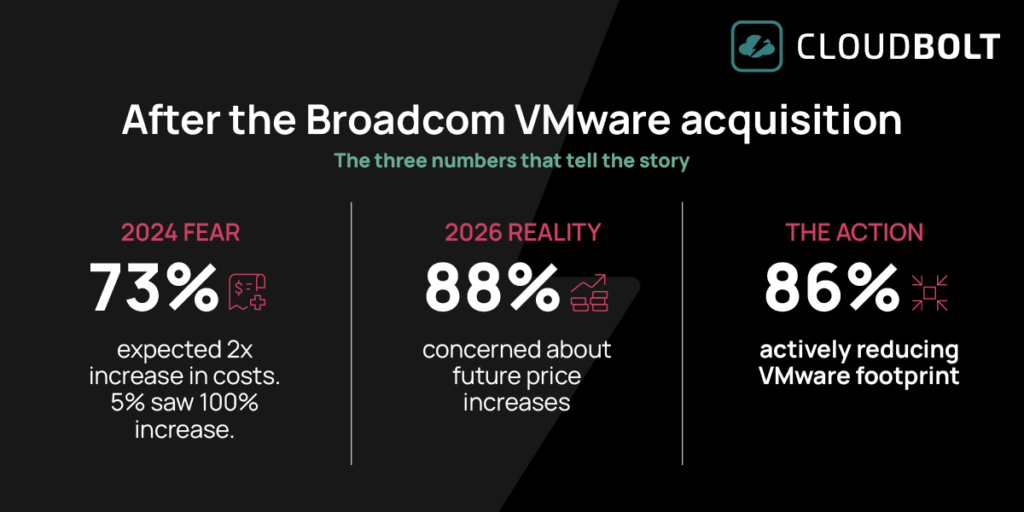
Our January 2026 research surveyed 302 enterprise IT decision-makers. Three findings are particularly relevant to executive planning:
- The initial shock was real, but not uniformly catastrophic. In 2024, 73% expected costs to more than double. By 2026, only 14% report 100%+ increases.
- The market expects the squeeze to continue. 85% are concerned about future price increases and say it is shaping decisions now.
- Enterprises are already executing phased exits. 86% report actively reducing their VMware footprint.
Even where the first increase was not catastrophic, the underlying constraint did not change. Most enterprises cannot unwind VMware quickly because it is embedded in the operating model across compute, storage, networking, DR, tooling, and skills. That lock-in exists regardless of the size of the first price move.
What pricing did change was sequencing. It pushed teams into phased dependence reduction and ongoing re-planning as the real blockers surfaced, especially in operations and recovery. A market that expected a clean exit has instead been forced into a longer program with more mid-course corrections.
This dynamic shows up as strategy churn as 56% report changing their VMware strategy two or more times since the acquisition.
“We have come to the realization that the transition from VMware is not an undertaking that can be measured in months, but rather a long-term marathon.” — IT Leader, Enterprise
Read the full research report
Read the report

Why this becomes more expensive over time
Three forces compound over time. The longer the program drags on, the more sequencing gets dictated by deadlines and operating load instead of intent.
1. Renewal timing compresses choices
Renewals create a sorting mechanism. Teams that reduce exposure early keep leverage and can sequence decisions deliberately. Teams that wait end up negotiating from deadlines.
This is where the winners and losers show up. Broadcom does not need every customer to stay. The economics work when a shrinking base pays more. If an organization arrives at renewal with a large trapped footprint, it subsidizes that model. If it arrives with credible alternatives and a smaller footprint, it buys negotiating power and time.
Each renewal cycle turns a strategic program into a commercial negotiation. When exposure is concentrated in critical systems, the next quarter’s work gets defined by contract timing rather than the safest sequence.
2. Dual-ops is unavoidable, and unmanaged dual-ops is costly
Most organizations will run VMware alongside one or more alternatives during the transition. In practice, this is not just running two platforms. It is running the incumbent platform, standing up the next platform, and running the migration program at the same time, often with the same people.
Without standardization across provisioning, governance, security operations, and DR, the mixed estate turns into exception handling. Runbooks multiply, tooling fragments, and incidents get harder to diagnose. The migration slows because the team is spending its time keeping multiple environments stable instead of shrinking the old one.
3. Executive scrutiny increases as the timeline becomes visible
As shown in our report, this has already become an executive issue. 41% report increased executive pressure since the acquisition. The most common sources are the CEO (19%), the Board (16%), and the CFO (15%).
When the program is not measurable and the path is not clear, pressure rises and decisions become reactive.
“Executive leadership pressure has definitely increased. VMware has become a regular topic at the leadership level. There’s more scrutiny around spend, more questions about vendor risk, and a stronger expectation that we have a clear, defensible strategy rather than just maintaining the status quo.”— VP/SVP of IT/Infrastructure, Enterprise
4. The opportunity cost is real
The hidden cost is what stops happening while teams work through this. The same people who would normally be modernizing infrastructure, improving resilience, or advancing AI initiatives are pulled into renewal triage, mixed-estate operations, and migration execution.
For many organizations, the largest cost is not a single renewal event. It is a multi-quarter diversion of attention and capacity that slows delivery elsewhere and leaves less room for strategic work.
The operating model the market is actually using
Two stats explain why enterprises feel stuck:
- Only 4% report a completed full migration away.
- 41% say they are staying with VMware while actively reducing dependence.
This is not a contradiction. The dominant operating model is to maintain VMware where required, while shrinking dependence elsewhere. For most enterprises, the “exit” is a multi-year dependence-reduction program, not a single cutover.
What executives should ask for to reduce risk and regain leverage
The most productive executive posture is to request proof of progress, not promises of completion, specifically:
- Renewal exposure map
Where is risk concentrated? Which systems create the highest leverage risk at the next renewal?
- Quarterly dependence-reduction targets
What will move, be replaced, or be retired in the next 2–3 quarters? What is the expected impact on footprint and renewal exposure?
- Dual-ops readiness plan
What will be standardized across platforms so the transition does not create operational sprawl?
- Constraint identification
What is the limiting factor right now: dependencies, skills, approvals, or operational tooling? What is being done to remove that constraint?
- Clear success measures
Measures such as renewal exposure reduction, net-new landing policy compliance, and operational standardization milestones are much more realistic than “migration complete.”
Three near-term actions that create clarity without overcommitting
Most organizations do not need a grand strategy reset. Instead, they need controlled learning and measurable progress.
1. Run a 10-workload pilot
Select 10 representative workloads and attempt to re-home or replace them. Use the result to identify true constraints and realistic effort drivers.
2. Set a net-new landing rule (60–90 days)
Define where new workloads should land by default. This prevents the VMware footprint from growing while the legacy program runs.
3. Build a dual-ops standardization backlog
Inventory the operational layers that will break first (monitoring, IAM, patching baselines, DR workflows, provisioning intake, cost/ownership visibility) and standardize them early. Without this, timelines expand and confidence erodes.
How leading organizations are managing dual-ops without the sprawl
The organizations making the most progress aren’t picking a single destination and betting the business. They’re investing in a control layer—a Cloud Management Platform—that lets them provision, govern, and operate across VMware and alternatives without duplicating workflows.
This approach gives them the ability to test new platforms, shift workloads incrementally, and maintain operational consistency without waiting for a “big bang” migration that may never come.
The practical takeaway
For most enterprises, the VMware decision window is open while the organization can still learn quickly, reduce renewal exposure, and standardize dual-ops. As renewal pressure accumulates, the same program becomes more expensive, more disruptive, and more reactive.
The report includes a practical reminder: unwinding a decade of process dependencies can take 18–24 months and is “far more complex than a standard cloud lift-and-shift.”
Read the full report: The Mass Exodus That Never Was: The Squeeze Is Just Beginning


Related Blogs
Why Cloud Resource Optimization Is Moving Beyond Recommendations
Cloud resource optimization has typically followed this pattern: teams identify inefficiencies, generate recommendations, review them, and apply changes where it feels safe to…