
Broadcom VMware Renewal 2026: What to Do in the 12 Months Before It Hits
If your renewal lands in the next twelve months, you already know the number is going to be worse than last time. The harder question is when to start doing something about it. Wait too long and you negotiate from zero leverage. Move too early and you are betting on assumptions that have not held up yet.
How much worse will it get? Across independent renewal analyses since the acquisition, first quotes have commonly landed at 2x to 5x the prior perpetual-plus-support cost, while negotiated outcomes tend to settle closer to 1.3x to 2x. Much of that first concession hides in details like the sixteen-core-per-CPU minimum. The opening number is not the real number — but you only get to the real one if you walk in prepared. There is also a hard clock behind all of this: vSphere 8 reaches end of general support on October 11, 2027, and it is the last release eligible for perpetual licensing, so a plan built in 2026 has room to absorb surprises that a 2027 scramble does not.
Our own research, a survey of 302 enterprise IT leaders in January 2026, backs up what most of you are already feeling. 93 percent have changed their VMware strategy at least once since the Broadcom acquisition, and 63 percent have changed it two or more times. A full exit is still rare; most expect to land on a stable hybrid estate rather than leave entirely. This is a market figuring itself out in real time, one renewal cycle at a time.
So rather than relitigate whether you should leave VMware, a question the numbers above have mostly put to bed, here is what actually needs to happen in the twelve months before your renewal lands.
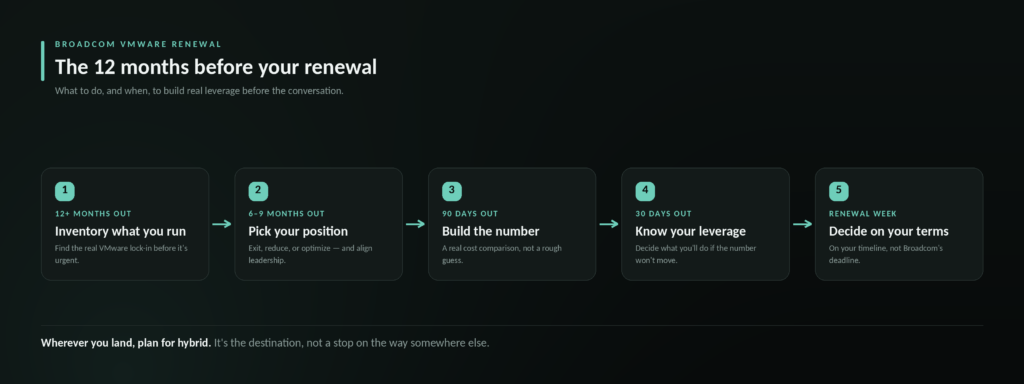
12+ months out: inventory what you actually run on VMware
This stage gets skipped constantly, precisely because it is not urgent yet. Do it early anyway, while you still have time to look properly instead of scrambling.
The question at this stage is what leaving would even involve, not whether to leave. Which workloads are tightly coupled to VMware-specific features. Which teams have built years of tooling and runbooks around it. Where the real lock-in lives, because it is rarely where people assume. In our research, the teams that eventually built real negotiating leverage were the ones who had done this exercise early enough that it was not a fire drill.
6-9 months out: decide your VMware negotiation position
By this point you should have enough information to pick a real position rather than a bluff. There are broadly three: full exit, workload-by-workload reduction, or staying and optimizing what you have. Each requires a different case at the renewal conversation, and each requires different internal buy-in.
This is also roughly when executive attention shows up whether you asked for it or not. In our research, 41 percent reported increased executive pressure since the acquisition, most often from the CEO and CFO. If leadership is going to have opinions regardless, better they show up now, while there is still time to align on a position, than during the renewal call. Expect the plan itself to keep moving, too. 63 percent of peers have already changed strategy more than once—that is normal, not a planning failure, so build a position that can flex rather than one bet you have to defend.
90 days out: build the VMware cost comparison leadership will ask for
Somewhere in this window you need a real cost comparison, not a rough guess. What does staying cost over the next contract term, against what a partial or full move would cost, including the migration work itself and not just the license line. Vague numbers get overridden by whatever Broadcom’s rep says in the room. Specific ones do not.
You also need to know whether your situation is normal. A lot of teams assume their price increase or migration pace is unusually bad when it is right in line with what everyone else is dealing with. Others are genuinely being hit harder than most and do not realize it, because they have never compared notes with anyone outside their own walls. If you want that comparison point before you build the internal case, the VMware Benchmark Survey puts your numbers against the same 302 leaders in five questions.
30 days out: walk into the Broadcom renewal knowing your leverage
By now the case should be built and the internal alignment should already exist. What is left is walking into the renewal conversation with a clear sense of what you are prepared to do if the number does not move, and what you are not.
Worth knowing going in: 86 percent of the leaders we surveyed remain concerned about future Broadcom price increases. Nobody in this market treats the current number as the ceiling. Whatever you negotiate this cycle, plan as if another one of these conversations is coming.
Renewal week: don’t let the deadline make the decision for you
The organizations in our research who ended up worse off tended to share one thing: they let the calendar force a decision they had not actually made. The ones who came out ahead, including plenty who chose to stay, had made a deliberate choice well before the deadline arrived.
Whatever you decide, decide it on your terms and your timeline, not on Broadcom’s.
Whatever you decide, plan for a hybrid VMware estate to stay
One pattern holds regardless of which position you pick: hybrid is the destination, not a stop on the way somewhere else. Most teams expect to stay hybrid, and the ones actively migrating are sending the bulk of those workloads to public cloud rather than to another hypervisor. The environment you negotiate for this cycle will almost certainly span VMware, one or more clouds, and Kubernetes for years.
The teams that stop paying a tax at every renewal are the ones managing all of it from a single control plane, so the next strategy change is a configuration decision rather than a rebuild. That is the difference between renegotiating your tooling every cycle and simply adjusting the mix.
Where you actually stand: benchmark your VMware renewal
All of this is easier with a real comparison point instead of guesswork about what is normal. See exactly where your renewal timeline and your options stack up against everyone else facing the same deadline.
See where your renewal actually stands
See how you compare



Related Blogs
How a large retail organization brought cloud self-service into Slack
A support team at a large retail organization we work with was spending its days on the same handful of…