
Kubecost alternatives
Visibility is step one, but recommendations sitting in a dashboard don’t reduce your cloud bill. StormForge automates the work Kubecost leaves behind — continuously, safely, at scale.
THE PROBLEM
Where Kubecost falls short

The recommendation backlog problem
Waste is visible. Recommendations exist. But applying changes falls back on engineering, introducing real risk:
- Request changes affect HPA behavior
- Traffic patterns aren’t always predictable
- Platform teams lack time to tune every service
Recommendations sit. Waste stays in the environment.

Why static rightsizing fails
Scheduled rule-based recommendations work in simple environments. But Kubernetes is dynamic:
- Traffic spikes and autoscaling events
- New deployments and usage shifts
- Application-specific behavior
Static approaches lose trust. Optimization stays manual.
StormForge + Kubernetes cost allocation (KCA)
StormForge by CloudBolt solves both sides of the problem. Kubernetes Cost Allocation (KCA) provides the visibility layer teams expect:
- Kubernetes cost allocation across clouds
- Namespace, label, and workload cost attribution
- Cloud bill ingestion and reconciliation
- Showback and chargeback reporting
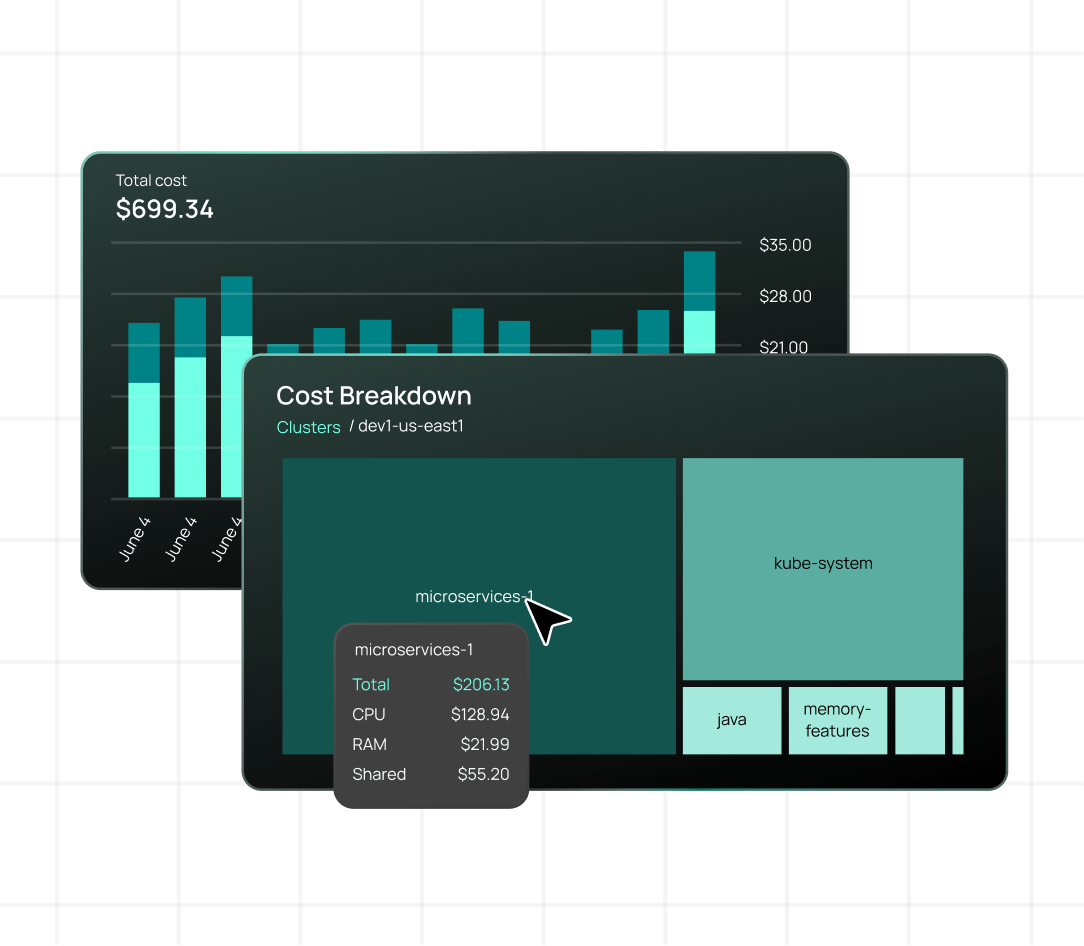
StormForge closes the gap Kubecost leaves open — continuously modeling workload behavior, coordinating rightsizing with HPA, and deploying changes safely. Instead of a recommendation backlog, teams get a continuous optimization loop.
K8s cost allocation
THE COMPARISON
Kubecost vs StormForge + KCA
Kubecost answers the question:
“Where is the waste?”
StormForge answers:
“What is the optimal configuration and how do we deploy it safely?”
| Capability | Kubecost | StormForge + KCA |
|---|---|---|
| Kubernetes cost visibility | Yes | Yes |
| Cloud cost allocation | Yes | Yes |
| Namespace & workload reporting | Yes | Yes |
| Continuous rightsizing automation | Limited | Yes |
| ML workload modeling | No | Yes |
| HPA-aware optimization | No | Yes |
| Automatic deployment of recommendations | Limited | Yes |
| Continuous optimization control loop | No | Yes |
Why Kubecost customers reevaluate their stack

Visibility without action
Teams quickly realize dashboards alone don’t reduce cloud spend.

Engineering time
Manual optimization across dozens of services and clusters becomes operational toil.

Dynamic Kubernetes behavior
More complex environments make simplistic optimization approaches harder to trust broadly.

Stack direction
Since the IBM acquisition, Kubecost is increasingly integrated into the broader IBM FinOps stack, prompting some teams to reassess their long-term tooling strategy.
What automated Kubernetes optimization looks like
A production-ready optimization workflow should do more than generate a recommendation. It should:
- Collect data continuously
- Model workload behavior over time
- Account for scaling patterns and application behavior
- Apply changes with clear guardrails
- Validate health after rollout
- Keep adapting as workloads change
Engineers stay in control, but optimization happens automatically.
Kubernetes rightsizing
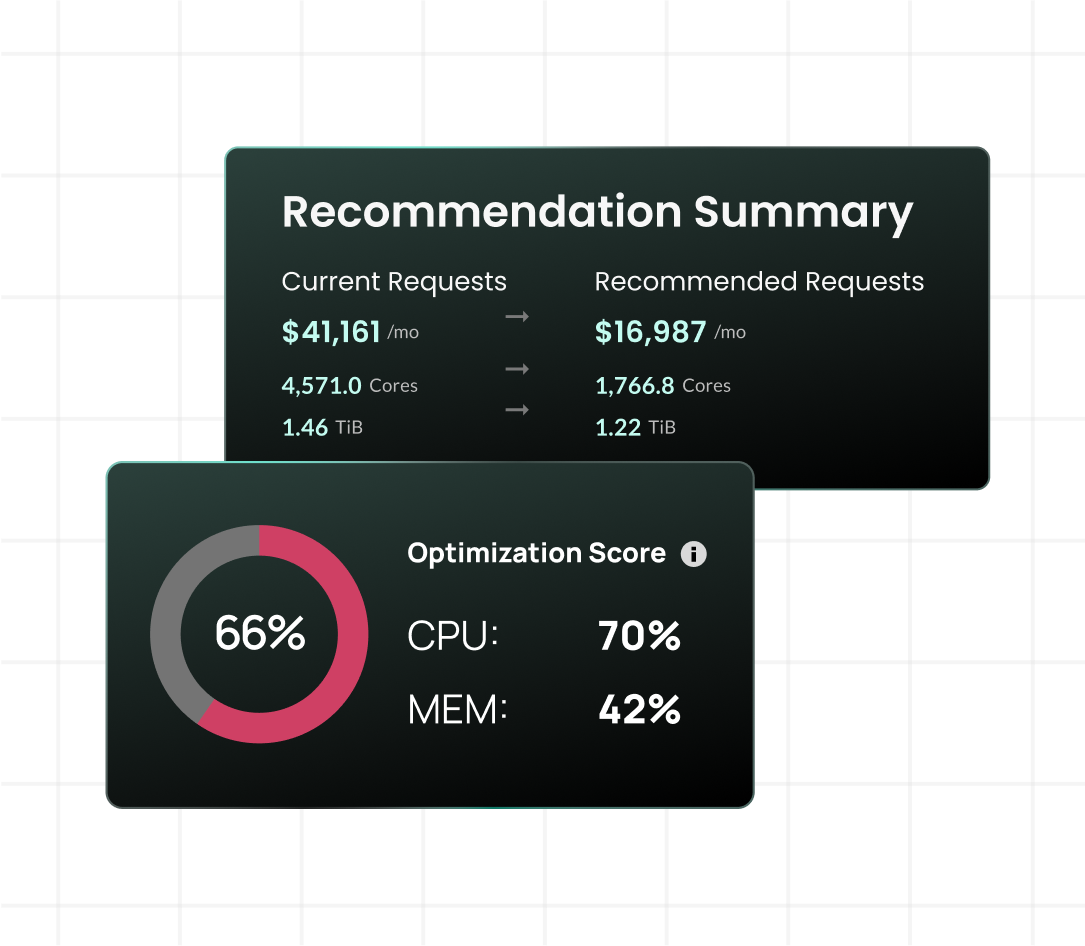
What teams usually improve with StormForge

Lower cloud spend
Automated rightsizing reduces persistent overprovisioning.

Less engineering toil
Teams spend less time reviewing and maintaining static optimization rules.

Safer scaling
Optimization is better aligned with workload behavior and HPA dynamics.
WHEN IT FITS
When Kubecost still makes sense
Kubecost may still be the right fit if your team:
- Only needs cost visibility
- Runs a small Kubernetes environment
- Manually manages optimization and won’t need to scale
- Is fully standardized on the IBM FinOps ecosystem
But for teams trying to reduce waste continuously at scale, visibility alone usually stops short of the real problem.
You don’t need another way to look at waste
Get started

Related resources
Top 10 Kubecost Alternatives in 2026
Kubecost has helped many teams understand where Kubernetes money goes, but following IBM’s 2024 acquisition, organizations are reassessing their cost management tooling. Some need deeper workload optimization that visibility alone can’t deliver. Others are navigating uncertainty around renewal or pricing pressure. This guide covers 10 platforms that teams are evaluating as alternatives to or complements of Kubecost in 2026. What is Kubecost? Kubecost is […]
How Acquia cut web node infrastructure by 65% with continuous Kubernetes rightsizing
Acquia modernized a platform that previously ran on roughly 26,000 EC2 nodes by moving to Kubernetes. The goal wasn’t just containerization—it was elastic scaling for traffic spikes without relying on fixed “small/medium/large” sizing. Results at a glance 65% reduction in web node footprint 99.99% availability delivered consistently 26,000 EC2 nodes as the legacy baseline modernized […]
The Kubernetes Automation Trust Gap No One Talks About
CloudBolt Research Report — March 2026 The Kubernetes Automation Trust Gap No One Talks About The selective distrust of autonomous Kubernetes rightsizing, and how to overcome it. 321 Respondents| Enterprise Orgs (1,000+)| 100% Kubernetes Practitioners 00Executive summary 01Automation is doctrine 02The moment trust breaks 03High belief, low delegation to automation 04This isn’t irrational 05Scale vs. […]