Top 10 Kubecost Alternatives in 2026
Kubecost has helped many teams understand where Kubernetes money goes, but following IBM’s 2024 acquisition, organizations are reassessing their cost management tooling. Some need deeper workload optimization that visibility alone can’t deliver. Others are navigating uncertainty around renewal or pricing pressure. This guide covers 10 platforms that teams are evaluating as alternatives to or complements of Kubecost in 2026.
What is Kubecost?
Kubecost is a Kubernetes cost monitoring and allocation platform that helps organizations understand how much their Kubernetes workloads cost. It analyzes Kubernetes metrics and cloud billing data to map infrastructure spend across clusters, namespaces, deployments, and teams. This allows engineering and FinOps teams to track how Kubernetes resources translate into cloud costs.
Key Kubecost capabilities
- Kubernetes cost allocation by namespace, workload, or team
- Cloud billing integration with AWS, Azure, and GCP
- Cost reporting and dashboards
- Budget alerts and anomaly detection
- Cost recommendations for resource usage
Kubecost is widely adopted because it provides granular cost visibility that many cloud providers don’t offer out of the box. However, visibility is only the first step in managing Kubernetes costs.
Why teams look for Kubecost alternatives
While Kubecost is excellent at cost reporting and allocation, many platform teams discover that knowing where money is spent doesn’t necessarily reduce their bills. As Kubernetes environments scale, organizations often need tools that go beyond reporting to automatically optimize infrastructure and dynamic workloads.
Common reasons companies evaluate Kubecost alternatives include:
- Limited automation: Kubecost primarily provides insights and recommendations, but most optimization actions still require manual implementation by engineering teams.
- Focus on visibility rather than optimization: Kubecost is fundamentally a FinOps visibility tool, not a workload or infrastructure optimization engine.
- Scaling complexity: As clusters grow across regions, accounts, and environments, teams often look for platforms that combine cost monitoring with automated scaling and rightsizing.
- Infrastructure-level optimization gaps: Kubecost does not manage node provisioning or cluster autoscaling strategies, and its support for instance selection and spot optimization is high-level.
- Workload rightsizing challenges: One of the biggest sources of Kubernetes waste is over-provisioned CPU and memory requests, but Kubecost’s rightsizing guidance may require additional tools to safely automate changes.
- Desire for integrated FinOps + platform engineering workflows: Modern platform teams increasingly want tools that integrate cost optimization directly into engineering workflows, not just dashboards for finance teams.
Top 10 Kubecost alternatives
Below are 10 of the best Kubecost alternatives in 2026, with their strengths and trade-offs.
1. StormForge
Best for: Continuous workload-level optimization
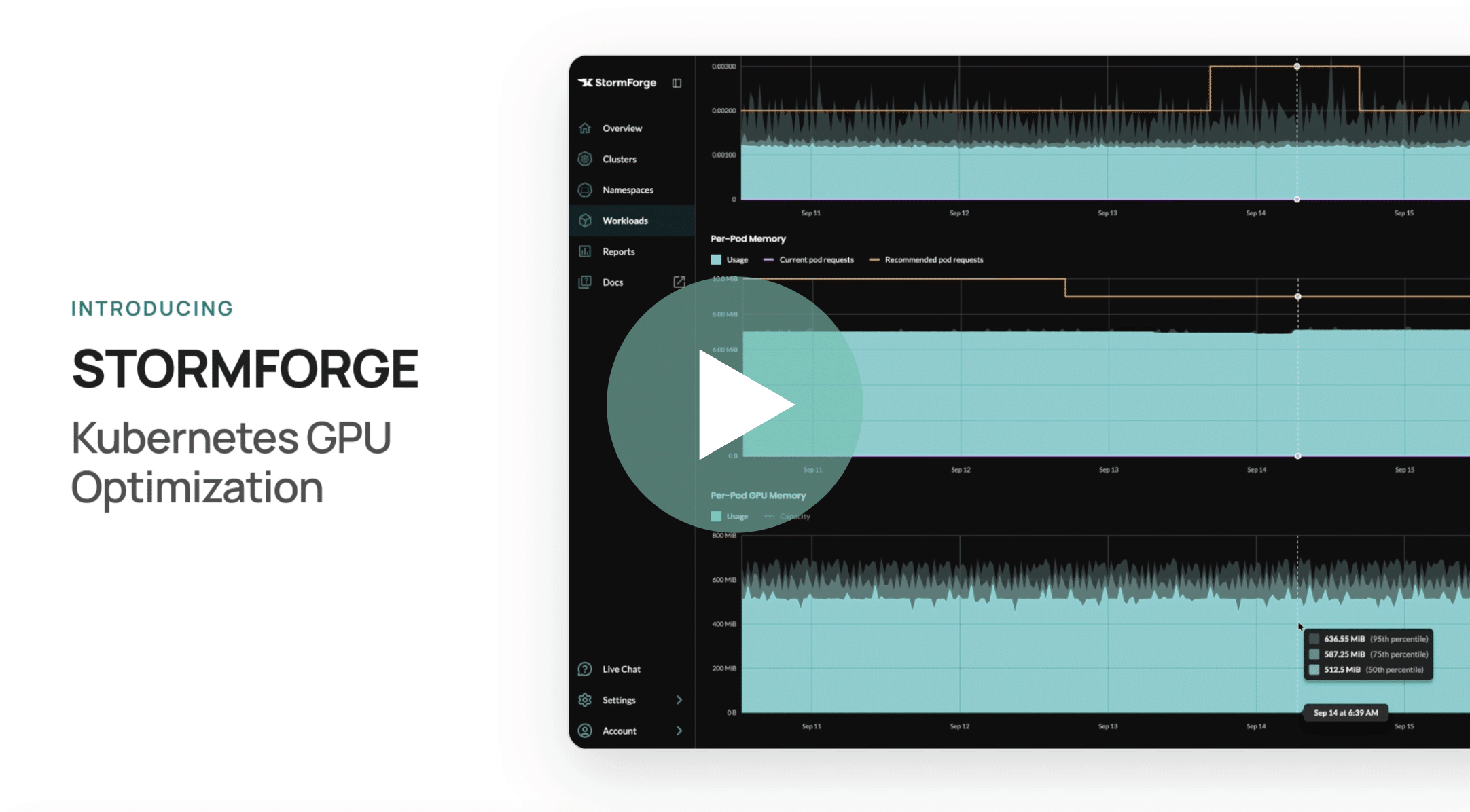
StormForge automates Kubernetes workload optimization by analyzing real usage patterns and tuning CPU and memory requests continuously. Unlike static recommendations, the platform uses machine learning and experimentation to safely optimize workloads without impacting performance. Each workload gets its own model to ensure daily and weekly patterns are captured and bursts are appropriately responded to, with safety guardrails including automatic rollback, OOM protection, and drift reconciliation. Built by former operations engineers, the product defaults to read-only mode and earns trust in stages—dev first, then test, then production—rather than requiring day-one delegation.
Pros
- Automated CPU and memory rightsizing at the pod level
- Patented machine learning–driven optimization
- Reduces overprovisioning while improving application reliability
- Bi-dimensional autoscaling: adjusts requests and HPA target utilization as a coupled pair, preserving scaling behavior
- Continuous optimization rather than one-time recommendations
- Java/JVM heap optimization (detects heap and optimizes alongside container resources)
- Progressive autonomy: start with recommendations, graduate to automation on your schedule
- In-place pod resizing with automatic rollback and fast-fail on ResourceQuota/LimitRange violations
- Works alongside HPA, KEDA, Karpenter, Argo CD, Flux
Cons
- Focused primarily on workload optimization rather than full FinOps reporting
- Limited node management capabilities
- SaaS only (no airgapped option)
2. CAST AI
Best for: Cluster infrastructure automation
CAST AI automates node provisioning, instance selection, and cluster autoscaling across multiple cloud providers.
Pros
- Strong automation for cluster infrastructure optimization
- Automated node provisioning and bin-packing
- Spot instance optimization
- Multi-cloud Kubernetes support
- Good cost visibility across clusters and workloads
Cons
- Costs use on-demand rates
- Must replace open-source tools like HPA or cluster autoscaler with Cast’s proprietary tool
- Limited flexibility around handling limits
- Pod-rightsizing feature requires use of their node autoscaling capabilities
3. nOps
Best for: AWS-focused Kubernetes optimization
nOps provides Kubernetes cost monitoring alongside automation for AWS cloud commitments and infrastructure.
Pros
- Strong optimization of AWS Savings Plans and Reserved Instances
- Kubernetes cost visibility and reporting
- Automated commitment management
- Multi-cloud cost monitoring capabilities
- FinOps-focused reporting and dashboards
Cons
- Best suited for companies with significant cloud spend
- Primarily optimized for AWS environments
- Less focused on deep workload optimization
4. Harness Cloud Cost Management
Best for: DevOps-integrated cost management
Harness Cloud Cost Management integrates FinOps directly into DevOps workflows, helping engineering teams track cloud spend during development and deployment.
Pros
- Integrated with the broader Harness DevOps platform
- Kubernetes cost allocation by cluster and workload
- Budget alerts and cost forecasting
- Automated idle resource detection and shutdown
Cons
- Limited infrastructure automation compared to some competitors
- Best value when already using the Harness platform
- More focused on governance than optimization
- Cost Optimization features deprioritized compared to broader DevOps features
See how much you’re overpaying for Kubernetes
Benchmark your cluster utilization against real-world data and find out where you’re leaving money on the table.
Run the free calculator5. Spot by NetApp
Best for: Spot instance optimization
Spot by NetApp automates the use of spot instances across cloud providers to reduce compute costs.
Pros
- Strong automation for spot instance usage
- Intelligent workload scaling and placement
- Supports Kubernetes and VM workloads
- Built-in cost analytics and forecasting
Cons
- Focuses heavily on compute infrastructure rather than workload tuning
- Savings depend heavily on spot market availability
- Some teams may need additional tools for workload-level optimization
6. Datadog Cloud Cost Management
Best for: Teams already running Datadog who want cost management and observability unified in one platform
Datadog Cloud Cost Management integrates cloud spend data directly with Datadog’s observability platform, allowing engineering and FinOps teams to correlate cost changes with performance metrics in a single view. Unlike standalone cost tools, Datadog surfaces Kubernetes cost allocation at the pod level alongside the infrastructure and application data teams are already using to run their systems.
Pros
- Kubernetes cost allocation at the pod level across EKS, ECS, and self-managed clusters
- Correlates cost spikes with performance data so engineers can see why costs changed, not just that they did
- Multi-cloud support across AWS, Azure, and GCP with FOCUS data ingestion
- Cost anomaly detection and alerting are integrated with existing Datadog monitors
- Kubernetes Autoscaling: multi-dimensional workload scaling recommendations and automation
- Commitment coverage and utilization management for RIs and Savings Plans
- 15 months of cost data retention for trend analysis and budgeting
- Embeds natively into Datadog dashboards, notebooks, and Service Catalog
Cons
- Full feature access requires existing Datadog Infrastructure Monitoring and Container Monitoring subscriptions
- Cost optimization depth is limited compared to purpose-built tools; optimization is secondary to observability
- Adds cost to an already expensive platform
- Kubernetes Autoscaling is newer and less mature than dedicated workload scaling tools
7. Apptio Cloudability
Best for: FinOps teams managing multi-cloud environments
Apptio Cloudability focuses on financial governance and cloud cost allocation rather than real-time optimization.
Pros
- Strong FinOps reporting and cost allocation
- Multi-cloud support across AWS, Azure, and GCP
- Budgeting, forecasting, and planning workflows
- Enterprise governance and reporting features
- Automated Reserve Instance and Savings Plan management across AWS, Azure, and GCP
Cons
- Limited automated infrastructure optimization
- Primarily designed for finance teams rather than platform engineers
- Kubernetes optimization capabilities are minimal
8. PerfectScale
Best for: AI-driven rightsizing insights
PerfectScale uses machine learning to analyze infrastructure usage and provide optimization recommendations.
Pros
- AI-driven workload rightsizing recommendations
- Capacity planning and utilization analytics
- Forecasting and anomaly detection
- Supports container and compute optimization
Cons
- Limited support for HPA workloads
- Limited automation for infrastructure orchestration
- Less Kubernetes-native automation compared to cluster-focused tools
9. Zesty
Best for: Combined storage and Kubernetes optimization
Zesty focuses on cost optimization across compute, storage, and cloud commitments.
Pros
- Optimization across Kubernetes workloads and storage
- Commitment management tools
- Predictive scaling capabilities
- Useful for organizations managing large storage footprints
Cons
- A broader scope may be unnecessary for teams focused only on Kubernetes
- Some features overlap with other FinOps platforms
- Platform complexity may increase operational overhead
10. OpenCost
Best for: Open-source Kubernetes cost monitoring
OpenCost is an open-source project designed to standardize Kubernetes cost monitoring.
Pros
- Fully open-source and extensible
- Integrates easily with Prometheus
- Detailed cost allocation by namespace and workload
- Large Kubernetes community adoption
Cons
- Limited automation for cost optimization
- Lacks enterprise FinOps capabilities
- Requires engineering resources to maintain and extend
- No built-in UI out of the box
- Default data retention is approximately 15 days without additional configuration
Choosing the right Kubecost alternative
The best Kubecost alternative depends on what problem you’re trying to solve. The table below groups tools by primary use case. Most teams need more than one category, and some tools span several.
| Category | Tools |
| Cost visibility | OpenCost, Cloudability, StormForge, Datadog |
| Node-level optimization | CAST AI, Spot |
| Workload optimization | StormForge, PerfectScale |
| FinOps Governance | Harness, Cloudability |
| Commitment and rate optimization | nOps, Cloudability |
Why teams choose StormForge by CloudBolt
Continuous workload rightsizing
StormForge automatically tunes CPU and memory requests for every workload using per-workload ML models trained on 28+ days of observed data. Each workload gets its own model that captures weekly patterns, daily cycles, and burst behavior. The result is less overprovisioning, lower costs, and fewer OOM kills, throttling events, and latency spikes.
Optimization without performance risk
StormForge adjusts resource requests and HPA target utilization as a coupled pair (patented), so changing pod sizes doesn’t break your autoscaling behavior. Recommendations are applied with automatic rollback, OOM protection, and fast-fail detection for ResourceQuota and LimitRange violations. Teams start in recommend-only mode and control when automation turns on.
Works with your existing Kubernetes ecosystem
StormForge integrates with common Kubernetes autoscaling tools and workflows, such as HPA, KEDA, Karpenter, and Cluster Autoscaler, allowing teams to optimize workloads while continuing to use familiar scaling and deployment strategies.
Engineering-first cost optimization
StormForge is designed for platform engineers, bringing cost optimization directly into Kubernetes workflows rather than relying solely on finance teams’ dashboards.
Kubernetes cost allocation with bill-level accuracy
With StormForge, teams can allocate Kubernetes costs down to the level of containers, pods, namespaces, and labels using real in-cluster metrics collected frequently by an agent. Costs reflect actual discounts and savings plans via FOCUS data ingestion, enabling accurate chargeback and showback across teams while revealing where optimization opportunities exist.
Java heap optimization for JVM workloads
Many Kubernetes environments run large numbers of Java applications, which require careful tuning of both container memory limits and JVM heap size. StormForge analyzes heap usage, garbage collection behavior, and container memory usage together, optimizing these settings simultaneously to help organizations reduce the memory footprint without causing GC storms or container crashes.
Proven cost reduction
By aligning Kubernetes resource requests with real demand, organizations can significantly improve cluster utilization and reduce cloud costs while maintaining application performance.
See how StormForge reduces Kubernetes costs without performance risk
Start free trial

Frequently asked questions
What is OpenCost, and how does it relate to Kubecost?
OpenCost is the open-source Kubernetes cost monitoring engine maintained by the CNCF. Kubecost is the commercial product built on top of OpenCost, adding enterprise features like multi-cluster support, SSO, and advanced reporting. If you’re evaluating Kubecost alternatives, understanding this relationship matters because some alternatives (like StormForge) solve a different problem entirely: optimization, not just visibility.
Does Kubecost optimize Kubernetes workloads?
Kubecost provides cost visibility, allocation, and recommendations, but its automatic rightsizing capabilities are limited. Optimization actions require manual implementation or a separate tool. This is the most common reason teams look for Kubecost alternatives.
What is the difference between Kubernetes cost visibility and cost optimization?
Cost visibility tells you where money is going. Cost optimization actually reduces the spend. Visibility tools like Kubecost, OpenCost, and Cloudability show you that a namespace costs $50K/month. Optimization tools like StormForge automatically adjust CPU and memory requests to eliminate overprovisioning, reducing the number of nodes needed and lowering the bill.
Can StormForge replace Kubecost?
StormForge can complement or replace Kubecost depending on your needs. StormForge includes Kubernetes cost allocation with bill-level accuracy down to the container level, including discounts and savings plans. It also provides automated workload optimization that Kubecost does not offer. For teams that need both visibility and optimization on a single platform, StormForge eliminates the need for a separate cost-monitoring tool.
What is Kubernetes rightsizing, and why does it matter?
Kubernetes rightsizing is the process of setting accurate CPU and memory requests for each workload based on actual usage patterns. Most teams overprovision because they set requests conservatively and never revisit them. Karpenter and Cluster Autoscaler provision nodes based on what pods request, not what they use, so overprovisioned requests directly translate to unnecessary nodes and wasted spend.
How does StormForge rightsize Kubernetes workloads?
StormForge uses patented per-workload ML models trained on 28+ days of observed usage data. Each workload gets its own model that captures weekly patterns, daily cycles, and burst behavior. When adjusting requests, StormForge also adjusts HPA target utilization as a coupled pair (bi-dimensional autoscaling), preventing the scaling behavior changes introduced by other tools. Recommendations are applied with automatic rollback, OOM protection, and drift reconciliation.
Does StormForge work with Karpenter?
Yes. StormForge complements Karpenter by rightsizing pod resource requests, which directly improves Karpenter’s bin-packing efficiency. Customers using both together have seen up to 70% node efficiency compared to roughly 20% with Karpenter alone.
How much does StormForge cost?
StormForge pricing is per vCPU, billed annually, with volume discounts at higher scales. A 30-day free trial is available with no credit card required. StormForge is also available as pay-as-you-go on AWS Marketplace. 80% savings, no compromise on reliability, 30 days, guaranteed.


Related Blogs
The Technical Guide to Kubernetes Rightsizing from LearnKube
The Technical Guide to Kubernetes Rightsizing from LearnKube is a comprehensive, hands-on guide to safely optimizing CPU and memory across…