A global enterprise software company used Kubecost to see what its Kubernetes workloads cost, but engineers rarely changed anything. It connected cloud cost to customers and margin with CloudBolt, handed rightsizing to StormForge, and put cost data in front of engineers inside the tools they already use. Automated rightsizing now runs on more than 700 clusters, and some engineering teams have cut their spend by more than half.
Where the MSP started
Billing at an MSP involves a lot more than reading a cloud bill. The provider gets partner discounts from AWS and Microsoft and decides how much of each to pass on. In return, customers get the MSP’s services and one invoice in place of several. A premium support tier, delivered by the MSP’s own engineers, adds another discount layer. Some customers pay in a different currency than their cloud costs arrive in, and finance needs every line marked as net revenue (capacity resale) or gross revenue (capacity as a service).
All of it had to be right on every invoice, every month. The team also built Excel attachments by hand for many invoices and spent four to nine hours per customer on each cost optimization report. Revenue and cost sat in different systems, so working out the margin on any one customer took manual effort.
Choosing CloudBolt
The MSP needed two things most cost platforms don’t offer. The first was rerating. Before a billing report reaches the finance system that generates the MSP’s invoices, every line has to reflect its own discount terms and match its customer IDs. “Most tools we looked at weren’t built for an MSP like us, and rerating was where they broke down,” said the MSP’s FinOps lead. “CloudBolt adapted to the way we bill, so at the end of the month our customers see exactly what they’ll be invoiced.”
The second was a portal the MSP could put its own name on. The provider holds the contracts with its customers directly, so a white-labeled tool meant customers could move over without new legal paperwork.
Some of what the MSP needed didn’t exist yet. “What sold us was a team that would listen and build it with us,” the FinOps lead said. “We talk every week, and some weeks I talk to CloudBolt more than to people at my own company.”
A weekly working rhythm
The partnership began in mid-2025, and the MSP’s accounts were onboarded in about two months. Since then the two teams have met every week. The MSP brings a problem raised by a customer or by its own finance and delivery staff. Both sides agree on the business outcome, CloudBolt tests the scenario against production-scale data, and what they learn goes into the next product cycle. They have tracked more than 40 joint activities so far, and more than 80% are complete.
What sold us was a team that would listen and build it with us. We talk every week, and some weeks I talk to CloudBolt more than to people at my own company.”
What the MSP runs on CloudBolt
- Customer experience. A white-labeled portal with the MSP’s name, logo and favicon, branded at the parent and child organization level. Permissions control what each customer can see, and SSO handles sign-in. A built-in support link opens a ticket with the MSP’s team, so customers don’t have to look up an email address.
- FinOps reporting. Cost trends, optimization reports, RI and savings plan coverage, budgets and commitment tracking. Teams can filter cost explorer down to a linked account or a single resource and save the view as a monthly report.
- Billing and finance. Custom rerating, monthly exchange rates applied the same way to customer views and to invoicing, and net or gross revenue classification on every line.
- Control at scale. Virtual tags, cost allocation rules, multi-cloud views and safe rule testing.
Executives see a summary dashboard, FinOps teams work in savings and commitment views, and finance tracks revenue, cost and margin. Reports export to PowerPoint, Excel, PDF or the API and carry the MSP’s own logo and colors, so they can go straight to a customer.
Results so far
“We can finally see revenue and cost in one place, so we know exactly what margin we make on every customer. We never had that before.” FinOps lead, cloud managed service provider
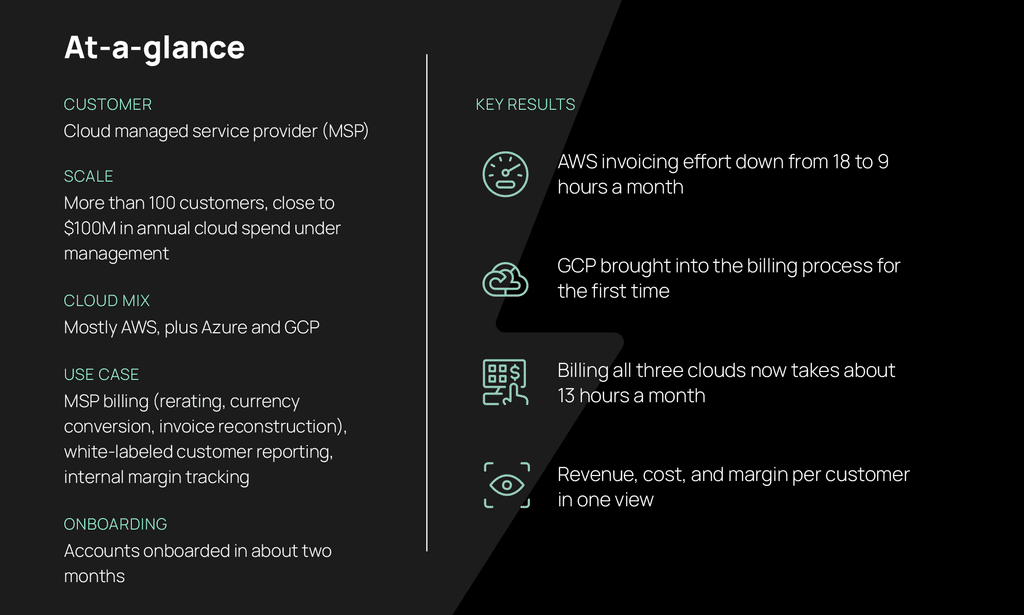
The MSP’s monthly AWS invoicing work fell from 18 hours to 9. GCP used to sit outside the billing process. Now it runs on the same platform as AWS and Azure, and all three clouds go through one standard billing workflow. Invoicing across all three now takes about 13 hours a month, with 9 for AWS, about 3 for Azure and about 1 for GCP. Reconciliation against hyperscaler billing data has improved too.
For the first time, the MSP sees revenue, cost and margin for every customer in one place, including its own internal accounts. It also has API access to its billing and cost data, which it didn’t have before.
More savings are expected once customers start working in the new interface. The MSP estimates that saved reports will replace its monthly Excel invoice attachments, saving 30 to 60 minutes per report, and will take most of the work out of cost optimization reports that currently run four to nine hours each.
We can finally see revenue and cost in one place, so we know exactly what margin we make on every customer. We never had that before.
What’s next
Customer accounts have been migrated, and the MSP’s own team works in the new interface every day. The next phase moves customers onto it in repeatable waves. That means finishing the remaining sign-offs and settling standard patterns for customer-facing reports, access and branding. The two teams are also looking at an AI assistant that could answer questions like what one customer spent on a set of linked accounts in a given month.
Download PDF


Related Customer Stories
Lobster Data customer story
When Lobster, Germany’s leading data integration and automation company serving 2,000+ customers worldwide, outgrew manual, fragmented infrastructure operations, they turned…