Microsoft Cloud Solution Provider (CSP) billing is inherently complex for Managed Service Providers (MSPs). It requires tracking frequent subscription changes, reconciling usage-based charges that arrive after the billing period, and mapping Microsoft’s detailed cost data to customer-specific pricing and margins.
Managing multiple tenants, services, and pricing models amplifies this complexity and increases the risk of billing errors and margin miscalculations. Effective CSP billing management requires real-time usage monitoring, automated cost attribution, and seamless integration with existing business systems.
CSP billing software addresses these challenges by automating subscription management, cost allocation, and invoice generation. CSPs receive the granular visibility needed for accurate client billing and profit optimization.
This article explains how to implement comprehensive CSP billing solutions. We cover software selection criteria, implementation strategies, and operational best practices for MSPs scaling their Microsoft cloud operations.
Summary of key Microsoft CSP billing software concepts
| Concept | Description |
|---|---|
| CSP billing fundamentals | Usage-based and license-based models with monthly cycles.They require automated tracking across multiple client tenants and subscription types. |
| Core CSP billing software features |
|
| Business system integration strategies | Integrate with
|
| Implementation and optimization best practices |
|
| Compliance and security considerations |
|
| Platform selection and evaluation criteria | Effective vendor selection considers technical integration depth, scalability requirements, operational features, and total cost of ownership. |
Stop losing time (and margins) to spreadsheets and manual reconciliation. CloudBolt’s Cloud Billing Platform gives you accuracy, automation, and control at scale—so you can focus on growing your business, not fixing billing errors.
Fundamentals of CSP billing
Microsoft’s CSP program operates on two licensing models.
- Seat-based billing applies to Microsoft 365 licenses, where costs remain fixed regardless of usage intensity.
- Usage-based billing governs Azure services where costs fluctuate based on actual resource consumption measured in compute hours, storage capacity, and network egress.
Seat-based tracking requires maintaining accurate user counts, handling license changes, and reconciling Microsoft’s reported consumption against internal records. Mid-month additions require prorated charges, correct markup application, and Partner Center file alignment. Discrepancies can create billing disputes that consume support time.
Usage-based Azure consumption introduces hourly metering, where single clients might operate 50-500 resources generating thousands of daily usage records. A Standard_D4s_v3 VM running 744 hours monthly generates separate line items for compute, managed disks, network egress, and associated services. MSPs typically aggregate these granular records into invoice summaries while preserving backup data for dispute resolution.
The Partner Center API provides access to usage data through several endpoints, but extracting actionable billing information requires understanding how Microsoft structures this data. Usage records arrive as line items tied to specific Azure subscriptions. Each record contains resource GUIDs, meter categories, consumed quantities, and rated amounts in the partner’s currency. Microsoft calculates the rated amounts by applying the partner’s wholesale pricing to raw consumption metrics.
The API structures this data hierarchically. Partners manage multiple customers, each customer can have multiple subscriptions, and each subscription generates usage line items. Retrieving a complete billing picture requires making sequential API calls:
- List customers
- Query subscriptions for each customer
- Pull usage records for each subscription within the billing period.
The challenges of manual CSP billing processes
This nested data structure makes manual billing extraction tedious and error-prone. The API requires sequential calls at each hierarchy level, creating a cascading workload:
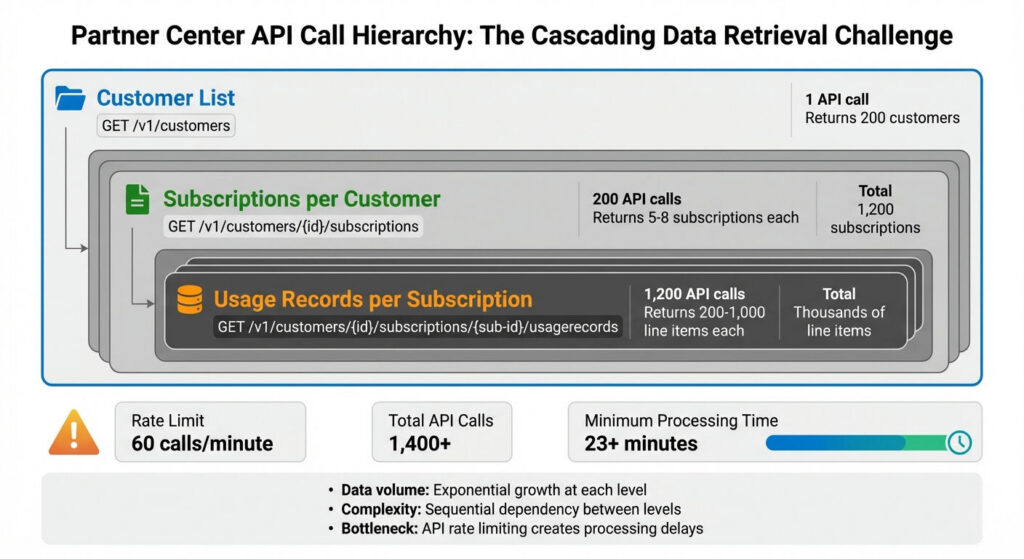
For a partner managing 200 customers with an average of 5 subscriptions each, this requires 1,000+ individual API calls just to retrieve the raw data before any pricing logic, aggregation, or invoice generation. Each subscription might return hundreds of usage line items that need individual processing.
API rate limiting compounds this challenge. Microsoft restricts Partner Center API calls to prevent system overload, meaning you can’t process all customers simultaneously during month-end.
Usage data timing creates additional complexity. There’s typically a 24-48 hour delay between resource consumption and API availability, so final invoices can’t be generated immediately on the first of the month.
Partners operating across regions face currency conversion decisions: use Microsoft’s rates, live market rates, or fixed negotiated rates? The API doesn’t expose underlying pricing tiers or promotional discounts, requiring partners to maintain separate pricing databases. Subscription lifecycle changes mid-month (upgrades, suspensions, cancellations) demand custom business logic for pro-rating charges—Microsoft doesn’t enforce specific policies here.
CloudBolt helps MSPs and distributors automate billing from end to end, eliminating manual reconciliation and unlocking margin protection at scale.
Explore Reselling & Distribution Capabilities to see how.
Core CSP billing software features
CSP billing software with the right feature set can make a huge difference to end-of-month financial reconciliation and bill management. Look for the following core features
Operational automation
Automated subscription lifecycle management eliminates manual provisioning that typically consumes 30-60 minutes per client. Modern platforms connect to Partner Center APIs to provision licenses, create subscriptions, and set up monitoring, all through workflows triggered by CRM closures, without IT intervention.
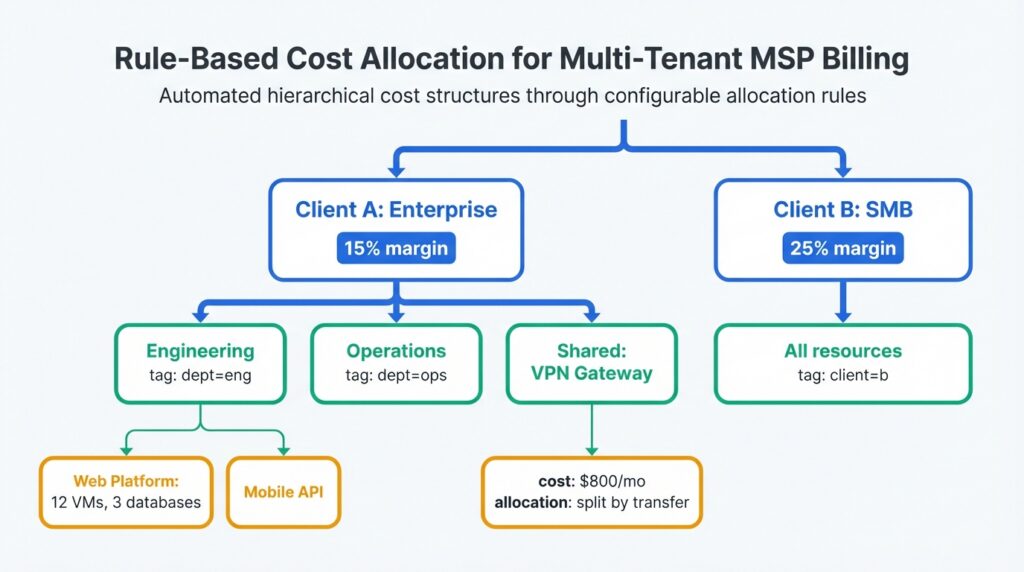
Multi-tenant cost allocation represents the most critical capability for MSPs to calculate margins and profitability. Rule-based engines handle complex scenarios.
Financial intelligence and control
MSPs need billing platforms that automate hierarchical cost structures through configurable allocation rules rather than requiring manual client-project mapping for every resource. CloudBolt, a multi-cloud management platform with integrated FinOps capabilities, demonstrates this through its chargeback system. This functionality enables MSPs to define parent-child relationships among clients, business units, and projects using policy-driven allocation rules.
Invoice generation
Invoice generation must accommodate diverse preferences. CloudBolt’s multi-cloud cost reporting automatically generates client-specific formats. Enterprise customers receive detailed 50-page reports, while SMB customers get 2-page summaries, both from the same underlying data.
Rate card management automatically applies client-specific pricing rules during invoice generation. When contracts specify 15% margins on compute but 20% on licenses, the platform applies the correct tier to each usage category without manual price lookup.
Enterprise integration
Automated anomaly detection depends on API access patterns that comply with Microsoft’s rate limits. Partner Center APIs impose request throttling based on partner tier, requiring monitoring systems to balance data freshness against available API quota. Most production implementations poll hourly or use Azure Cost Management APIs for near-real-time visibility.
| Monitoring Dimension | Detection Threshold | Alert Timing |
|---|---|---|
| Budget overruns | Daily spend >110-120% forecast | 4-hour intervals |
| Unusual deployment | >5x normal velocity | Real-time |
| License waste | Unused >30 days | Weekly batch |
| Underutilization | <10% for 7 days | Daily analysis |
CloudBolt’s Integration APIs provide connectivity beyond Partner Center. PSA systems, CRM platforms, accounting systems, and client portals need real-time bidirectional flow rather than nightly batch synchronization.
Business system integration strategies
Billing platforms operate most effectively when integrated with existing business systems rather than functioning as isolated cost aggregators. Let’s review a couple of strategies for that.
Time tracking and consumption billing integration
MSPs managing Azure environments face challenges consolidating invoices when combining professional services time with consumption-based infrastructure costs. Engineers spend 10 hours managing a client’s Azure environment, generating billable time tracked in professional service automation(PSA) systems (ConnectWise, Autotask, Datto), while Azure infrastructure consumption incurs separate usage charges via Partner Center APIs.
Without integration, billing administrators manually correlate these data sources. For e.g., they may pull time entries from PSA platforms, retrieve Azure costs from billing systems and then combine them in spreadsheets to create unified invoices showing both labour charges ($150/hour × 10 hours = $1,500) and infrastructure costs (Azure consumption + margin = $8,200).
CSP billing software with integrated billing features eliminates this manual consolidation by connecting PSA systems directly with consumption billing data. The integration handles project-based billing scenarios where clients run multiple concurrent Azure engagements requiring separate cost visibility. For example, a migration initiative that consumes $5,000 per month in temporary infrastructure, a production platform costing $15,000 per month, and a development environment spending $2,000 per month.
The CSP billing software should ideally provide tag-based allocation rules that combine with PSA project codes and automatically attribute Azure consumption to specific projects. CSPs can then generate invoices that break down both time-based services and infrastructure costs by engagement, without manual cost distribution.
CRM system connectivity
CRM system connectivity automates quote-to-cash workflows that currently require manual data transfer across systems. When sales teams prepare Microsoft CSP quotes in Salesforce or HubSpot, they estimate consumption based on client requirements like 50 Microsoft 365 E3 licenses, 10 Azure VMs, 500GB storage, and managed services support.
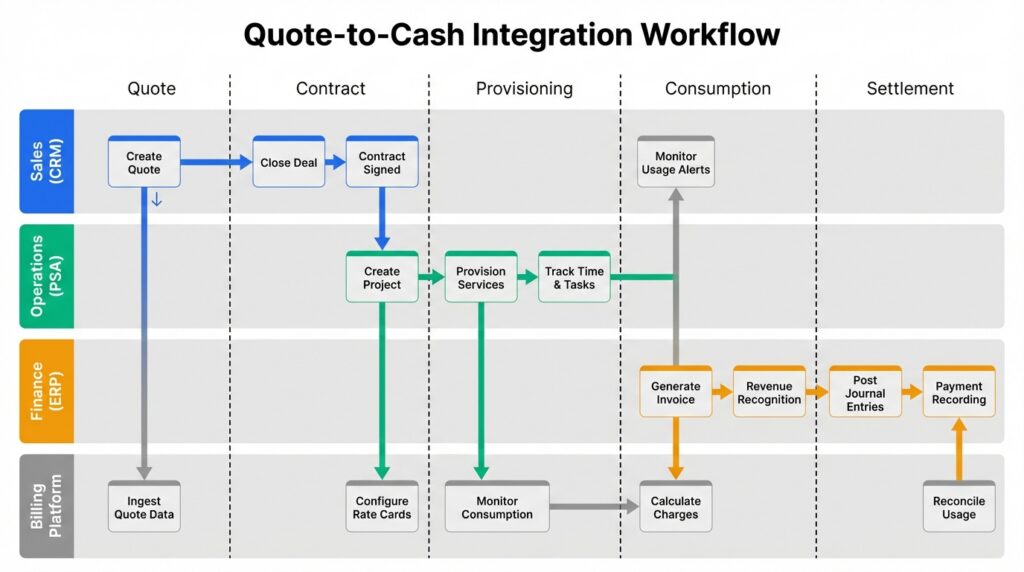
Once deals close, the CSP billing software should automatically ingest these quote details, establishing baseline expectations on how usage monitoring compares against actual consumption to detect variances.
MSPs without CRM-to-billing integration spend 2-3 hours per new client manually transferring quote data into billing systems, configuring rate cards, and establishing monitoring thresholds. Automated workflows reduce this to 5-10 minutes of validation time. They allow sales operations to scale without proportional administrative overhead that erodes deal profitability before services even begin.
Financial system integration
Financial system integration handles the accounting complexity required to transform usage data into recognized revenue. ERP systems (NetSuite, QuickBooks, Xero) require specific journal entry formats, including GL account codes, cost center attribution, and revenue recognition schedules that comply with ASC 606.
CSP billing softwares typically generate these entries automatically. They post Azure consumption to specific revenue accounts, categorize Microsoft 365 licenses separately, record professional services time distinctly, and link all entries to source invoices for audit trail maintenance.
Revenue recognition becomes particularly complex for long-term contracts with prepaid commitments. When clients purchase 12-month Azure reserved instances or commit to annual Microsoft 365 enterprise agreements, MSPs must recognize revenue appropriately across the contract terms rather than booking it all up front.
Your CSP billing software should handle these scenarios through automated deferral schedules and periodic revenue release calculations.
Data synchronization
When clients add Microsoft 365 licenses through the Partner Center, that change must be reflected in
- PSA systems (for support ticket routing)
- CRM platforms (for license utilization tracking)
- Billing systems (for invoice adjustments), and
- Client portals (for current subscription display).
Data drift occurs when these different systems contain conflicting information about client subscriptions, leading to operational confusion and billing disputes. For example, when sales teams negotiate 15% margins but billing systems apply 20% by mistake, the discrepancy creates client disputes and confusion in margin analysis
Hence, your CSP billing software should include real-time synchronization features to maintain a single source of truth for client pricing across all systems. Quote-to-cash system integration ensures pricing alignment across the entire client lifecycle.
Audit and traceability
Audit and traceability requirements demand comprehensive logging of every billing transaction. The CSP billing software must track:
- Who changed rate cards (user, timestamp, old value, new value)
- When cost allocation rules were modified (before/after configurations with justification), and
- How invoice amounts were calculated (source usage records, rate cards applied, allocation percentages, markup tiers).
This logging supports internal audits, external regulatory examination, and client dispute resolution. CSPs can demonstrate billing accuracy by reconstructing the exact calculation methodology from historical data.
Implementation and optimization best practices
MSPs upgrading from spreadsheet-based billing, basic accounting software, or first-generation cloud cost tools to dedicated CSP billing platforms face operational challenges during the transition period. Existing client billing relationships, historical cost data, and established invoicing processes must continue functioning while new systems come online. The migration approach determines whether the transition strengthens or disrupts client relationships.
Migration planning and parallel systems
Migration planning must account for the operational risk of simultaneously moving multiple client billing relationships to a new CSP billing software system. The recommended approach runs parallel systems during 60-90 day validation periods. Legacy systems continue generating production invoices while the new CSP billing software processes identical data for comparison.
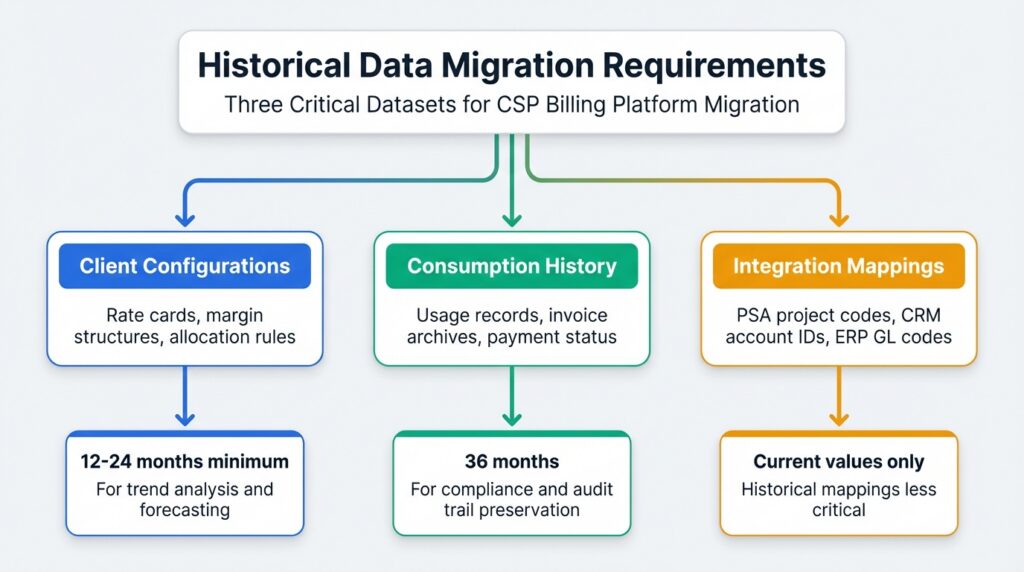
This parallel operation identifies discrepancies in cost allocation logic, rate card application, and integration synchronization. Legacy platforms might round unit prices differently, inconsistently apply time zone offsets, or handle mid-month subscription changes with alternate logic. Identifying these variations during parallel runs prevents post-migration surprises where client invoices suddenly differ by 2-3% without a clear explanation. Small percentage differences can become material at scale when managing $500K+ monthly billing volumes.Historical data migration: Parallel validation requires transferring sufficient historical data from legacy systems to enable meaningful comparison and baseline establishment. New billing platforms need access to past billing cycles to calibrate allocation algorithms, validate pricing model consistency, and establish the usage baselines that distinguish normal variations from genuine anomalies. Three critical datasets require extraction and migration:
Client onboarding automation with templates
Client onboarding automation standardizes the setup process that determines initial billing accuracy. Template-driven approaches within the CSP billing software should define standard configurations for client tiers. For example, we can use the next templates:
| Template | Key Features |
|---|---|
| Enterprise client | Multi-department hierarchies with cost centers, detailed invoice formatting (resource-level breakdowns), client portal (customizable dashboards), and monthly business review reports (consumption analysis, optimization). |
| SMB client | Simplified single-department structures, consolidated invoicing, basic portal access (invoice downloads), and quarterly review cadence. |
| Trial client | 30-60 day evaluation subscriptions, built-in spending caps, daily consumption alerts, and automatic conversion workflows to production billing structure. |
Template-based standardization cuts setup time from 2-3 hours per client to 10-15 minutes while improving configuration consistency across the customer base. When every enterprise client onboards with identical cost allocation frameworks, operational teams develop expertise in managing those patterns rather than constantly troubleshooting unique configurations that require custom support.
Cost allocation transparency
Transparent cost allocation prevents disputes by helping clients understand how charges are calculated. When clients question invoices, support teams reference allocation rules with supporting usage data rather than defending opaque calculation processes.
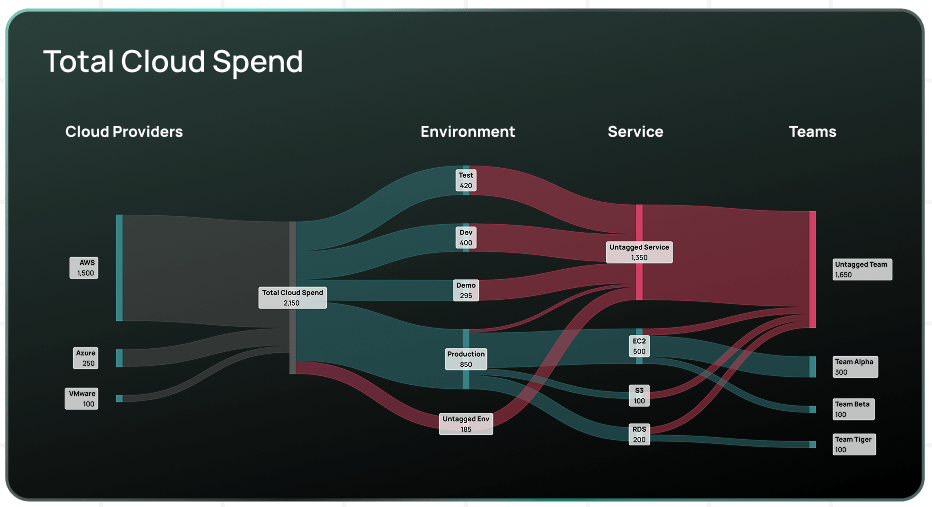
Comprehensive tagging directly impacts billing accuracy. Organizations with strong tag enforcement can attribute costs precisely to customers and projects. In contrast, poor tagging compliance creates unallocated cost buckets that either erode MSP margins or require manual reconciliation before invoicing.
Performance monitoring metrics
Performance monitoring of the CSP billing software tracks operational health metrics that predict problems before they impact billing accuracy:
| Metric | Healthy Range | Warning Threshold | Critical Impact |
|---|---|---|---|
| Partner Center API success rate | >99.5% | <99% | Incomplete usage data causes under-billing |
| Tag compliance percentage | >90% | <75% | Unallocated costs erode margins or cause disputes |
| Invoice delivery success | >98% | <95% | Payment delays from missed email delivery |
| Margin percentage variance | ±2% from target | ±5% | Pricing errors or allocation failures |
These thresholds should be tuned based on customer workload characteristics. Development environments with variable usage patterns may require greater tolerance to variance to prevent false positives during normal scaling events. In contrast, stable consumption benefits from tighter thresholds that quickly catch genuine anomalies. Monitoring systems should support customer-specific threshold customization rather than applying uniform rules across diverse portfolios.
Compliance and security considerations
CSP partner compliance and consent management
Microsoft CSP compliance begins with Partner Agreement requirements governing data handling, consent management, and customer relationship maintenance. Partners must obtain proper admin consent from customer tenants before accessing billing data through Partner Center APIs. Consent establishes the delegated admin relationship that enables subscription management. Billing software must:
- Track consent status per customer
- Alert when consent expires or gets revoked
- Prevent unauthorized data access when consent lapses.
Audit preparation requires maintaining comprehensive documentation of billing processes, allocation methodologies, and system access controls. Microsoft conducts periodic partner audits examining billing accuracy, customer consent management, and data security practices.
CSP billing software that supports audit requirements should provide detailed logs showing :
- Who accessed which customer data
- When rate cards changed
- How allocation rules evolved over time
Financial controls and approval workflows
Financial controls that implement SOX requirements focus on segregation of duties and approval workflows to prevent fraud or errors. Billing software configurations should separate access privileges. For example:
- Rate card management requires the finance team’s approval before changes take effect
- Invoice generation operates automatically through system rules without manual intervention
- Payment recording involves accounting staff independent from billing operations
- Customer portal access grants clients visibility without modification privileges
Billing platforms need configurable multi-level approval workflows that route sensitive operations through designated approval chains based on operation type and impact thresholds. Rate card modifications, for instance, require dual approval—sales operations confirms contract terms while finance validates margin targets—before the billing system applies new pricing. The platform enforces this workflow by holding changes in pending status until both approvers sign off, preventing unauthorized discounting that erodes profitability or accidental pricing errors that trigger client disputes.
Similar approval routing applies to other high-risk operations: pricing exceptions exceeding defined thresholds escalate to executive review, bulk client migrations require both technical and business approval, and invoice adjustments above certain dollar amounts need finance manager authorization. The software should maintain audit trails showing who requested changes, who approved them, when approvals occurred, and what justification was provided.
Data security and multi-tenant isolation
Data security in multi-tenant environments demands strict isolation between customer billing data. Client A should never see Client B’s consumption patterns, pricing structures, or invoice details through system configuration errors or inadequate access controls.
CloudBolt’s continuous optimization implements tenant-level data partitioning that prevents cross-customer visibility. Portal users authenticate to specific customer contexts with permissions limited to their assigned accounts.

Privacy regulations (GDPR, CCPA) impose requirements on how billing platforms collect, store, and process customer usage data. European clients exercising GDPR rights can request data deletion. Billing platforms must remove customer records while preserving financial data required for accounting compliance and audit trails. This balance requires selective data retention policies: consumption telemetry can be aggregated and anonymized after 90 days, but invoice records must persist for 7 years per accounting standards.
The MSP landscape is shifting fast. Hear experts discuss how to deliver what customers want most: better cloud spend optimization, automation, and multi-cloud flexibility.
Conclusion
Billing automation reduces the manual work of reconciling usage files and generating invoices, freeing MSP finance teams to analyze margins, optimize pricing, and identify profitable growth opportunities. The platforms succeeding in this market combine technical depth—comprehensive Partner Center API integration, sophisticated multi-tenant cost allocation, real-time usage monitoring—with operational awareness of how MSPs actually run multi-customer cloud practices.
Effective implementations reduce billing cycle time based on portfolio scale. For 50-100 customer tenants, automation reduces the month-end close from 40+ hours to 8-10 hours. For portfolios of 200+ tenants, automation prevents 100+ hours of manual reconciliation, maintaining 10-15-hour close cycles through exception-based workflows that have staff handle only edge cases rather than processing every customer manually.


Related Blogs

How to get Slack notifications when StormForge applies recommendations
The StormForge Applier does its job quietly. It watches for recommendations, applies patches to your workloads, and moves on—no fanfare,…
When Hardware Triples in Price, Idle Capacity Becomes a Line Item.
A platform leader at a Fortune 50 company recently told his app teams something that I keep thinking about. The message was very…

StormForge vs ScaleOps: A Technical Comparison of Kubernetes Rightsizing Approaches
StormForge and ScaleOps both automate Kubernetes resource optimization, but they take meaningfully different approaches to how much control you hand over and when. This page walks through the differences in architecture, automation model,…